Feeds:
Posts
Comments

Posts Tagged ‘whisky’

Introduction

A pour of Ben Nevis 13

A pour of Wild Scotsman Ben Nevis 13

Wild Scotsman single cask: 1992 Ben Nevis 13 year, 46%, Cask #693

I discovered Wild Scotsman whisky via Twitter, where the Wild Scotsman himself, Jeffrey Topping, is an active member. Following the Twitter profile link to his site, I discovered that this is an American who travelled to Scotland to learn about whisky making, somehow got in tight with Master Distiller John McDougall, and then started his own whisky company. How’s THAT for an exciting way to live the American dream? He offers a couple of his own vatted malt expressions, a number of single casks from different distilleries, and U.S. distribution of some John McDougall single cask selections.

Intrigued, I looked through the available Wild Scotsman bottlings online at Sam’s Wine and Spirits store, located in Chicago. I found this single bourbon cask Ben Nevis 13 year, a distillery from which I’ve been wanting to try an expression. There was no information about this bottling on the Wild Scotsman web site, so I dropped Mr. Topping a note asking for information on it, and he sent me the following:

The Ben Nevis was my first single Cask bottling after the release of my first signature Vatted malt. At the time I was in an apprenticeship with the only Master Distiller and Blender in the World, John McDougall of Scotland. On one of our tours we traveled up to the Ben Nevis Distillery to meet with his first apprentice, Collin Ross, who is the distillery manager at Ben Nevis even today. It was a bit surreal to have a behind the scenes tour of Ben Nevis with two men whose combined career in whisky spans over 70 years. They can forget more in a day than is written in most books about Scotch whisky.

After the tour we had a wonderful lunch in the reception. Lamb Broth Stew, sandwiches, and some good conversations about some of the history both of these men have lived and continue to live. We continued to the board room and we sampled some of the casks we owned. The samples were pre-arranged as there is an extensive amount of paperwork to withdraw samples and other matters which are all policies of both the government and Nikka which owns Ben Nevis. It was quite interesting to have cask samples of an Ex-Sherry, Ex-Port-Pipe, and Ex-Bourbon, which are all components of the single malt brand. One could almost pick out the role each component plays in making the brand. I was blown away about how subtle and sweet the Ex-bourbon cask of Ben Nevis I owned had matured and knew at 13 years this cask would be ready for bottling.

I reduced the proof down to 46%,with no added color, no chill filtration. It is a great dram for the heat.

Tasting notes

Straight out of the bottle, I notice a bit of a pungent smell, reminding me of furniture polish, and possibly something slightly sour. While it’s a bit sharp, I don’t find it particularly offensive. Others might have a different reaction. Of note, letting a glass of this Ben Nevis sit for 15-20 minutes (with a watch glass on it) seems to help this expression more than I’ve noticed with other whiskies I’ve tried. My notes are based on drinking it after it sat for 20 minutes in the glass.

On the nose, I get some alcohol, but not a lot. I don’t feel particularly inclined to water it down any further. The primary scents are lemon drops and yogurt, along with some hay or cut grass in the background. One of the three times I tried it, those traits combined to make me think of iced tea with lemons in it. Overall, it’s a “light” nose, even with that sharp initial attack.

On the palate, this Ben Nevis has a nice body to it. It’s reasonably think and oily. Most impressive, though, is the reaction on the tongue. I’ve got sweet and salty going, with a little sourness, and finally a slight dark chocolate bitterness. Lots of tingling going on all over the tongue! There’s a drying on the tongue that provides some additional tingling on the sides.

The finish doesn’t bring back much of the nose at all, which I found a little bit unexpected. However, there does seem to be a bit of a white pepper sensation, and a hint of malt. Perhaps a slightly stale malt. The pepper sticks around for a while, as does the drying sensation on the tongue.

Back Label

Back Label

Conclusion:

The bottom line is that I find this Wild Scotsman Ben Nevis quite enjoyable. Nothing earth-shattering, but a nice light summer dram, with a little extra bite on the tongue compared to something like Bunnahabhain 12. In fact, I’d say my overall enjoyment is similar to the Bunna 12, so I would rate this the same at 83/100 points. One point down for having to wait a bit for the initial furniture polish attack to ease up, but a point added back for the extra zip in the mouth. As for deciding between the Ben Nevis and the Bunna, it will come down to whether I’m in the mood for lemon drops or apples and cinnamon.

Reading through the notes about Ben Nevis on Malt Madness (Johannes doesn’t seem to care much for the expressions distilled in the 1990s), I’m thinking Jeffrey Topping did a nice job with this Ben Nevis release. At $58, I think it’s a fair value for a non chill-filtered single cask. I’ll certainly be keeping Wild Scotsman on my radar, and will be trying more of their expressions. I’m curious about the vatted malts, but also quite intrigued by the John MacDougall Bladnoch single casks. In time, hopefully I’ll be able to report back on both.

Other Opinions

I was just about to write that I couldn’t find any other opinions on this rare single cask release. Then I found a review on Malt Advocate. I had looked in the review section under Wild Scotsman. It’s actually under Ben Nevis:

  • Malt Advocate – John Hansell was very impressed with this release, awarding it 87 points! I’m not ready to go that high yet, but maybe after I improve my ability to distinguish subtleties in a light bourbon-casked malt I’ll see things differently. John’s obviously got a lot more experience than I do.

Quick Take

Here’s my “quick take” graphic for Wild Scotsman Ben Nevis 13. For more info about this format, and my rating system, see this post.

Wild Scotsman Ben Nevis 13

Read Full Post »

Introduction

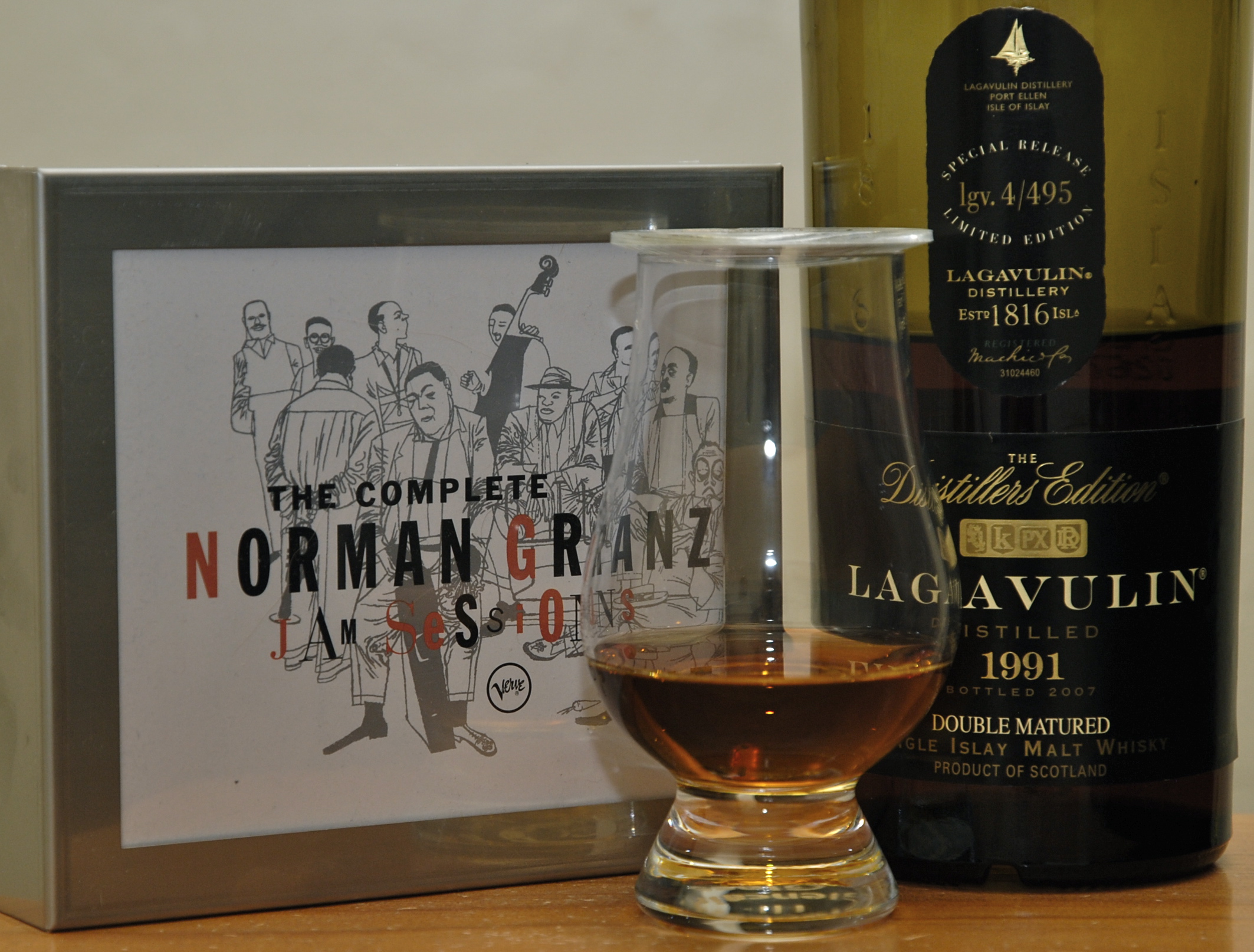
As I await the arrival of my purchased copy of Whisky & Jazz by Hans Offringa, I thought I’d go ahead and do my own Whisky & Jazz post. I was sitting with a couple of Lagavulins recently, going through my classic jazz collection, and I came across an amazing pairing: Lagavulin 1991 Distillers Edition and The Complete Norman Granz Jam Sessions, by Verve. This bottle of Lagavulin was bottled in 2007 at 43%.

Norman Granz and Lagavulin DE

Norman Granz and Lagavulin DE

I found out about The Complete Jam Sessions three years ago, reading about it in John Marks’ The Fifth Element article in Stereophile magazine. You can follow the link to read his article and learn all about this amazing compilation of recordings. Here are just some of the musicians Granz pulled together for these jams, recorded in 9 sessions during the early 1950s: Charlie Parker, Oscar Peterson, Ben Webster, Dizzy Gillespie, Roy Eldridge, Buddy Rich, Herb Ellis, Stan Getz, Count Basie, Charlie Shavers, and Johnny Hodges. Pretty crazy, huh?

Listening and tasting notes

I want to start with the same Ballad Medley from disc 1 that John Marks raved over, which I listened to last night while drinking the Lagavulin 1991 DE.  I started up the song on my stereo system and poured the Laga while Barney Kessel kicked things off on guitar…

On the nose, the Lagavulin DE has the classic Lagavulin peat smoke. Lost from the standard Lagavulin 16 bottling, at least to my nose, is the apples and vanilla. Instead, an extra sherry presence from the PX casks is presented, rising up seductively through the smoke in the form of dried fruit and ripe berries. Meanwhile, Charlie Parker comes in on alto sax, playing Dearly Beloved. He’s drawing me right in with a solid performance, but things only get better…

On the palate, Laga DE provides a nice strong body, tickling the sweet and salty taste buds and maintaining a strong peat presence. There seems to be a little richer, weightier mouth feel than on the 16 year. Next up on the Ballad Medley is Ben Webster on tenor sax with The Nearness of You. He builds on the foundation provided by Parker with increased dynamics in the intonation that brings out more emotion.

The finish on the Laga DE does not disappoint. It’s got the same explosion of smoke that is so great on the 16 year, and the sherry stays right there front and center in the mix. And the length? I could sit through the rest of the 17 minute Ballad Medley contemplating the finish. After Webster, Johnny Hodges steps in with his rendition of I’ll get by. I was already entranced by the mastery of Parker and elegance of Webster, but Hodges blew me away. I could swear he was feeling inspired by the previous solos, and his tenor sax just oozed emotion. Marks said he was “all gelatinous” by the time Flip Phillips came in 4 minutes later, but I melted about 20 seconds into Hodges’ solo.

Similarities of dram and jam:

Lagavulin 1991 DE brings the bold flavors of Islay peat and Pedro Ximenez sherry together in a way that totally works. You might expect a disjointed effort (especially since the sherry is just a “finish”), but there’s a great interplay and harmony of flavors. Similarly, the Norman Granz jam sessions bring together some of the best jazz players of the time. Sure, there is showmanship involved. On the ballads, however, it’s all about showing emotion, and the competition at that level draws you into the song and results in a whole that is greater than the sum of the parts.

Tasting conclusion:

When I first tried the Lagavulin DE, my feeling was that it was better than Lagavulin 16. However, I’ve compared them a number of times since then, and I’ve decided that it’s like trying to decide if a Cadbury chocolate bar with caramel is better than the original. To me, they’re equally good, just different. That’s how I now feel about the two Lagavulins. With the DE, you get the extra sherry influence, and perhaps a bit more body on the palate, but you lose the apples and vanilla that provide additional complexity on the Laga 16. Right now, I’m on a sherry kick, so I might give a half point extra to the DE, but I’m going to round down and give it a 91/100 to match my score for Lagavulin 16.

Listening conclusion:

When I first started listening to the Jam Sessions, I gravitated to the ballads, listening to them over and over. Since then, I’ve really gotten to where I get a kick out of listening to ALL of the songs in the box set. It’s amazing to hear these huge names in jazz belt out solo after solo. Right now, I’m really digging disc 3, with a couple of great trumpet players strutting their stuff…Roy Eldridge blowing great solos throughout, and Dizzy Gillespie joining him on Stompin’ at the Savoy. However, for the purposes of this post, it’s the ballads that go so beautifully with the Lagavulin DE in the evening after the kids have gone to bed.

Finally, I don’t know that I’d recommend either of these to beginners. On the whisky side, I’d recommend checking out the Lagavulin 16 before venturing into the Distillers Edition. Likewise, I’d check out some of the core body of work from people like Charlie Parker, Oscar Peterson and Dizzie Gillespie before jumping into these extended jam sessions. Maybe next time I’ll write about a good introductory whisky & jazz combination. You can download the Jam Sessions set for $45 on Amazon, or $50 on iTunes, but I’d go for the CD version from Amazon for $59 so you can enjoy reading through the included booklet.

Other opinions

Lagavulin DE 1991

  • WHISKYFUN.COM by Serge – Serge seems conflicted between his desire to dislike “finished” whiskies, and the fact that the Laga DE is pretty awesome. He gave it 92 points blind, but does a seemingly tongue-in-cheek downgrade to 91.
  • Malt Advocate – 91 points here, also…and a better rating than Lagavulin 21 (which I agree with).
  • Whisky For Everyone – Some info about the Lagavulin distillery, along with some nice notes on the Laga DE.
  • YouTube – Peatluvr gives his video review of the Lagavulin 1991 DE

The Complete Norman Granz Jam Sessions

Of course, there’s the Stereophile review that I linked to in the introduction, and the Amazon reviews. Additionally:

  • AllAboutJazz.com – A write-up on this set by critic Norman Weinstein. His overall opinion of it seems to be positive, even though it seems like he doesn’t want to like it (he refers to the up-tempo songs as “noisy, competitive joustlings among hornmen”. Also, given my earlier comments about Ballad Medley on disc one, it’s probably not surprising that I disagree with his assessment that Johnny Hodges seems disinterested. I do agree with him, though, that the ballads are the “real deal.”

Lagavulin DE Quick Take

Here’s my “quick take” graphic for Lagavulin 1991/2007 DE. Scoring-wise, it’s almost identical to my Lagavulin 16 rating, with a little less on the nose and a little more on the body. For more info about this format, and my rating system, see this post.
Lagavulin 1991 DE Quick Take

Read Full Post »

Quick Take

Here’s my “quick take” graphic for Lagavulin 16. For more info about this format, and my rating system, see this post.

Lagavulin 16 Quick Take

Introduction

[Update: I did a follow-up review of Laga 16 using a 2009 bottling in December, 2009]

I was going to do a write-up on a great whisky/jazz combination, involving Lagavulin 1991 DE. However, I decided I should post my impressions of the core Lagavulin 16 expression before delving into that special release, so I’ll put that one off a couple of days.

My introduction to Lagavulin 16 (bottled at 43%) came from a 20 cl bottle that I ordered from The Whisky Exchange. The bottle had a bad cork, got caught up in customs, and arrived with about half of the contents emptied into the packing box (kudos to TWE on their packing, as the smell was completely contained within the box). Upon opening the box, I was hit with a very strong medicinal smell, like band-aids and iodine. Taking in that strong odor from the spilled bottle, I was a bit skeptical of this Lagavulin stuff. This was to be my fourth Islay malt, and I was afraid I had finally met my match. However, as you can verify for yourself, the smell of a whisky spilled on paper is not indicative of the smell (nose) that you get out of the glass.

Oops! Bad cork.

Oops! Bad cork.

The Lagavulin 16 I’m writing about tonight is from another 20 cl bottle. This one is from the Classic Islay Collection 2007 gift pack, although the code on the bottle, which starts with “L6”, appears to indicate that this one was bottled in 2006.

Tasting notes

On the nose, that medicinal iodine smell is there, but to me, it serves as a backdrop to the other scents, not really standing out on its own. I’m struck by a strong fruity smell, like a combination of berries and apples. I could swear there is a sherry cask influence here, but I haven’t read anything definitive about the casks used for this expression. Perhaps it’s a mixture of bourbon and sherry casks, as there is a nice, creamy vanilla note coming out (bourbon cask influence). Finally, mixed in with the fruit and sweets is an equally strong, earthy peat influence with some associated smoke.

If you’re new to Islay whiskies, the iodine/peat might stand out to you the first couple of times you take in the nose. Stick with it, and you’ll see all of the elements integrate together beautifully over time.

The palate is substantial, with some sweetness there, but you really start to notice the peat influence. Then it grips your tongue, and becomes very dry. If you like a drying sensation from your whiskies, this one has it in spades. There’s also some spiciness, but I wouldn’t say this is one of the more spicy drams I’ve tried.

On the finish, there is an explosion of camp fire peat smoke. Hello, Islay! The berries come back, too, mixing with the smoke in a very pleasing way. I’m also reminded of the medicinal notes, but it’s still in the background. This finish goes on for a long, long time.

Conclusion:

Lagavulin 16 really hits the spot for me. It’s got earthy peat, combined with just the right amount of berries and vanilla sweets, along with enough of a medicinal character to keep you on your toes. I guess I COULD imagine an improvement with a little more of a Talisker-like pepper on the palate and finish, and possibly even a little more body. I’m reaching, though. There is an amazing balance as it stands. With the enchanting nose and endless finish, I can sit in my favorite chair, listening to a long classic jazz jam session, completely satisfied and free of life’s worries. Surely that’s worth 91/100 points.

Other opinions

  • WHISKYFUN.COM by Serge – A very good, but not great score of 89/100 by Serge. Although, I don’t see much in the way of negatives in his notes. He also discusses this classic malt from the vantage point of having tried many other versions.
  • Whisky for Everyone – They call this “a true ‘try before you die’ single malt whisky.” I agree!
  • Whisky Magazine – Huge scores of 9.5 and 9.75 from Michael Jackson and Jim Murray respectively. This article is from about 10 years ago, however. I believe I’ve read some opinions that Lagavulin 16 isn’t quite the “beast” that it was back then. I’m not sure how Murray rates the latest version in the current Whisky Bible.
  • YouTubeIslayScotchWhisky provides a very positive review. He mentions that it tastes almost exactly like it smells. That’s a good point. With the exception of my getting a lot more smoke on the palate/finish, I was amazed at how much of the profile carried through from beginning to end. Next, peatluvr gives a great account of how he didn’t like Lagavulin when he first tried it (early in his scotch drinking days), but now loves it.

Read Full Post »

Quick Take

Here’s my “quick take” graphic for Bunnahabhain 12. For more info about this format, and my rating system, see this post.

Bunna 12 Quick Take

Introduction

Bunnahabhain 12

Bunnahabhain 12

Bunnahabhain [boona-havn] is the only active Islay distillery that I had yet to sample. The distillery is owned by Burn Stewart, and my understanding is that this is the core single malt used in the Black Bottle blend. I guess I put them at the bottom of my Islay list because their standard, [virtually] unpeated offerings are not really in the Islay taste profile category. They do offer peated expressions. In fact, I have a sample of their “Moine” peated whisky from Feis Ile  2009 that I still need to try. I wanted to experience their standard product first, though. The Bunnahabhain 12 that I’m writing about here is the core expression for this distillery, and is bottled at 40%.

Tasting notes

On the nose, I get honey sweetness and apples (sometimes cinnamon apples), but then some red [dried] fruits start to come out. Is this partially matured in sherry casks? Sometimes I get a whiff of black licorice, while at other times it comes across as malty. Finally, a little fresh wood at the end. I’m not picking up any peat or smoke on the nose. It’s not super complex, but I’m really enjoying this…I could sit with this dram for a while, just enjoying the aromas.

On the palate, it’s still fruity, with an average body that almost seems a little peaty/earthy, even though I couldn’t pick it up on the nose. It’s very easy on the palate, but could use more oomph, kind of like the Dalmore 12 I tried recently. No alcohol harshness whatsoever, though.

For the finish, the fruit and light peat die off very quickly, leaving just a maltiness on the tongue that sticks around for a medium duration. Sometimes I think there’s a hint of smoke on the finish, but maybe that’s just in my head. This is not a “smoky” dram. Still nothing offensive going on here. This goes down VERY easily.

Conclusion:

Light and refreshing, this is yet another “dangerously drinkable” whisky. I quite enjoyed spending time with the nose, which was a nice surprise. Though the palate and finish are mild, the experience is very smooth and pleasant. I kept wanting to go back for more. You need the right mentality going in, though. If you’re in the mood for a classic, peaty Islay malt, this isn’t going to do it for you.

For me, I would rate this at 83/100, noting that it is very enjoyable and easy to drink, with an above average nose (for a light whisky). What a great whisky this is for a summer afternoon! If you value the palate/finish experience more than the nose, you’ll likely rate this a bit lower, and possibly even be disappointed. What can I say? I’m a “nose” man.

Other opinions

  • Whisky for Everyone – Great information about the distillery, as well as some nice tasting notes. [Update]
  • whisky-pages – A solid 3 out of 5 stars, they’re picking up a level of peat and smoke that I’m just not getting.
  • WhiskyNotes.be – You palate/finish aficionados might relate a little more closely to this review than mine.
  • WHISKYFUN.COM by Serge – A generous 84 points in this review of a 2006 bottling, but I see he lowered his score to 82 for the 2007 bottling, with the average Malt Maniacs Matrix score being 80 points.
  • YouTube – Here’s a video from IslayScotchWhisky.

Read Full Post »

Introduction

Black Bottle 10 Year

Black Bottle 10 Year

Tonight I’m trying Black Bottle 10 year blended scotch whisky, bottled at 43% alc./vol. On the bottle, it says “Finest Scotch Whisky with a Heart of Islay” When they say it has a heart of Islay, they mean it. This blended whisky apparently contains whisky from all 7 Islay distilleries (this is pre-Kilchoman). Black Bottle is owned by Burn Stewart Distillers, who also own Bunnahabhain [boon-a-havn], so you can expect for there to be a fair amount of that particular Islay single malt in this blend. Of course, as a blend it also contains grain whiskies. When I first bought this bottle, I tried it by itself and liked it. However, I immediately ran across postings in the Whisky Magazine forums that recommended mixing in a few drops of your favorite Islay single malt. Black Bottle does a great job of taking on the character of that malt, and I discovered that I really enjoy it with a few drops of Caol Ila or Ardbeg. Tonight, however, I’m focusing on Black Bottle 10 as a stand-alone whisky.

Tasting notes

On the nose, there seems to be a cereal grain scent that gives away the fact that this is a blend, perhaps even a hint of rubber. Leaving the glass sitting for a bit, this seems to go away almost completely. Now, getting down to business…I get fruit over sweet peat that reminds me of a combination of Bunnahabain and Caol Ila. There’s also some smoke there, but not a big camp fire smoke like Ardbeg or Lagavulin. Finally, there seems to be a fresh wood component, and maybe a hint of iodine that reminds me of Laphroaig QC or 10 CS.

The palate is very gentle and fruity. The feel reminds me of Bunnahabhain 12. This is such a warm, friendly spirit. No bite at all from the grain whiskies. It’s not a heavy body, but it’s not watery either. Thankfully, they bottled it at 43% and not 40%.

On the finish, there is a smoke that seems to separate from the spirit and rise up through the nostrils. Once again, I’m reminded of Caol Ila, more than the smoke from any of the other peaty Islays. It’s not as strong or as long lasting as a straight Caol Ila, though. The remaining liquid on the back of the tongue once again reminds me of Bunnahabhain 12. No…it IS Bunna 12. It’s a sweet, malty flavor that’s fairly light, but does stick around for a little while. It’s interesting how these components separate on the finish and co-exist as two completely different entities.

Conclusion:

This really is a wonderful blend, and a fantastic introduction to the world of Islay malts. It tastes great by itself, and it can transform into your favorite Islay single malt (especially Caol Ila) just by adding a few drops. Unfortunately, Black Bottle is no longer producing this 10 year expression. I believe their younger NAS (No Age Statement) bottling is the only one currently in production. Here in AZ, however, I can still find the 10 year in a number of stores for $35-$40, but have yet to see the NAS. I’ve read that the NAS expression is very good as well, but if you have a chance to pick up this 10 year, I strongly recommend doing so while you can.

You’ll see really high scores in the Other Opinions below, but I’m thinking those are relative scores, taking into account that this is a blend. I feel like a score of around 84/100 is appropriate for this very enjoyable whisky, relative to the other whiskies I’ve tried. The price makes it an incredible value. As a blend, this is an amazing whisky, and one you should try to get into your cupboard.

Other Opinions

  • Malt Advocate – 93 points…wow! In their ratings scheme, it does say that this means it’s “one of the best for its style.”
  • whisky-pages – Another postive review, I think they found it to be a bit more peaty and phenolic than I did.
    • Also on the whisky-pages web site, a great overview of Black Bottle, discussing the heritage, character, and the blend itself.
  • Whisky Magazine – Scores and notes from Michael Jackson and Jim Murray, with both giving it a 9/10 score.
  • WHISKYFUN by Serge (Scroll down to “Five Islander Blends”)- A review of BB NAS and 10 year. Note the 10 year is from 2003 and bottled at 40%, so maybe a little weaker than the one I tried.

Read Full Post »

Introduction

The Dalmore 12

The Dalmore 12

This post is about The Dalmore 12 (OB), 40% ABV. It’s matured in 50% American white oak ex-bourbon and 50% oloroso sherry wood casks. The Dalmore line has been recently updated, with changes made to the whisky as well as the packaging. The “old” 12 year was matured in 70% bourbon and 30% sherry casks. I’ve had Dalmore on my list of distilleries to try, but hadn’t really sought any of the expressions out. I guess that’s fine, as there was apparently a bit of a delay getting these new releases onto the shelves in the United States. My local specialty shop just got a few of these 12 year bottles in within the last month.

Tasting notes

Here’s what it says about the taste on the box:

Orange marmelade and rich spice, elegant and refined with concentrated citrus and oloroso sherry, an aftertaste of great abundance.

It’s been AGES since I tasted “great abundance”. I can’t wait!

On the nose, I get a Terry’s dark chocolate orange ball with some cinnamon potpourri spices. Also, I’m reminded of a wood-paneled library with leather bound books. I then work through to some fruity sweetness – I want to say peaches in brown sugar syrup. At the end, I get a hint of tea leaves (it comes and goes, though). I felt the overall presentation of the nose was a bit laid back.

On the palate, it’s sweet and somewhat watery. It reminds me a bit of Coca-Cola, which is something I get with bourbons as well. Heading into the finish I get another hint of spice, and some drying on the tongue. Finally, a reminder of the sherry component before it all fades away fairly quickly (maybe a hint of smoke in the nostrils at the end).

Conclusion:

This was my first Dalmore. I’m very satisfied with the flavor profile, and look forward to trying other Dalmore expressions. My only gripe with this one is that you have to really go after the laid back nose, and the palate and finish are too gentle. It goes down extremely easy, but I want more oomph. You’ve got a great profile Dalmore…give me more of it! That being said, I’ll very much enjoy working my way through this bottle. I see no reason to disagree with the 83/84 point scores by Serge Valentin and John Hansell (links below).

The unboxing

This may be a bit over the top, but I took a video of the unboxing of my Dalmore 12, much like you would see somebody do with the release of a new Apple product:

Other opinions

  • WHISKYFUN.COM by Serge – He likes this one, and rates it 3 points higher than the previous version of the 12 year.
  • What does John know? (Malt Advocate) – John mentions pineapple upside down cake on the nose. I can certainly see that in place of my peaches in syrup notes.
  • whisky-pages – Some great notes by Gavin and Tom. I can totally identify with their descriptions. They say the finish is longer than the old Dalmore 12. Wow…that one must have been crazy short!

Read Full Post »

Introduction

Following on the heels of my Laphroaig 10 CS Batch 001 post, I’m trying another 30 ml Laphroaig sample from whiskysamples.eu. This one was specially bottled for Feis Ile 2009 (5000 bottles total), with post-festival sales only through the Friends of Laphroaig online store for £40. I’m talking about the Laphroaig Cairdeas [car-chase] 12 year, bottled at 57.5% ABV. This “Cairdeas” bottling is not to be confused with the 2008 Cairdeas, also bottled specially for the Feis Ile festival, which was an 8 year expression.

John Campbell, distillery manager at Laphroaig, chose the bottling this year for the first time (last year, Robert Hicks, the master distiller, chose the Cairdeas casks). John chose a single vintage 12 year that has been matured in Maker’s Mark bourbon casks, bottled straight from the cask with simple barrier filtering. He states on the Laphroaig web site that to his tastes, this is “nearly a perfect expression of Laphroaig of this maturity.

Tasting

On the nose, this Laphroaig is kind of fruity, like the 15 year. However, the fruit is toned down a bit compared to the 15, and there seems to be citrus on this one, on top of apples and pears. There is a very noticeable fresh wood smell similar to what I noted on the  Laphroaig 10 CS. There’s also some peat smoke, but I’m not really getting the tar that comes with the 10 year Laphroaigs.

On the palate, it’s still got some fruit going, as well as more noticeable peat. There’s also a stronger pepper here than I noticed with even the 10 CS. At full strength, it’s prickly on the tongue, but it doesn’t hit you right away with “heat” like the 10 CS. Wow…this is a very enjoyable sensation. Adding a little water, it’s not quite as prickly, but the pepper remains, thankfully.

On the finish, it’s drying on the tongue, and then a nice strong peat smoke comes up through the nostrils. Here’s where it got really interesting. I could swear this is kind of a coal smoke similar to what I get with Caol Ila. Wow! I didn’t see that one coming. It lasts for quite some time. Quite nice.

Conclusion:

I’ve only had this one 30 ml sample, but I’m going to go ahead and rank this as my second favorite Laphroaig after the 30 year. I think it takes the best elements of the 10 CS and 15 year, and adds a new twist at the end. It’s great at full strength or watered down. Based on my Caol Ila comparison, where I did some theoretical ratings (Laph 15 = 90; Laph 30 = 93), I’d put this one at 91 points. I can’t tell you how disappointed I am that this isn’t available in the United States. If you have a chance to purchase a bottle of Cairdeas 12, and you like Islay malts, I would highly recommend going for it.

Other opinions

It appears that I like this one a bit more than others who have reviewed it so far. Everybody below agrees that it’s good, but they seem to pull up short of calling it great.

  • WhiskyNotes – Ruben tastes the 2009 Cairdeas 12 and proclaims it to be a major improvement over last year’s 8 year festival bottling. He gives this one 88 points, vs 82 for last year’s Cairdeas. He still rates the 10 CS Batch 001 just ahead of this one, though.
  • WhiskyFun – Another by proxy report via the Lindores boys. They like the Cairdeas 12 slightly more than the 10 CS Batch 001, giving it an 89/100 rating, versus 88 for the 10 CS.
  • Caskstrength.net/TWE Blog – Co-report from the Feis Ile festival with notes on the Cairdeas 12. No rating, but more agreement that this is a big improvement from last year.
  • KingFisher Blog – 88 points for Cairdeas 12 vs. 92 points for 10 CS Batch 001. I wonder if, in these head-to-head comparisons, the Cairdeas 12 ends up feeling a little light at the end compared to the 10 CS, thus losing out. I tried them on consecutive nights, but not head-to-head in the same night.

Read Full Post »

Introduction

Laphroaig 10 CS Batch 001 in a nosing glass

Laphroaig 10 CS Batch 001 in a nosing glass

In his Christmas 2008 video blog [available on the Laphroaig web site], John Campbell (Laphroaig distillery manager) talked about a change in the Laphroaig 10 years Cask Strength offering, starting in 2009. Apparently, it’s been standard practice for Laphroaig to produce the 10 CS in two batches each year, but it’s been difficult to have each batch produced at the same strength. Starting with their first 2009 batch in February, they’ve decided to start distributing each batch as its own unique release, with the batch number on the label, and the strength varying per batch (between around 54% and 58%). The Feb ’09 release (# 001) is at 57.8%.

This batch approach seems to be gaining in popularity, as it entices whisky connoisseurs into buying multiple batches to compare (you can see this with Aberlour a’bunadh). Apparently, Laphroaig was showing off batch 001 at Feis Ile 2009, and Luc Timmermans was able to secure a bottle and make 30 ml samples available through whiskysamples.eu. This is how I got the sample I’m writing about now.

Tasting notes

On the nose, I’m immediately hit with a medicinal scent that quickly turns to a woodiness and smoke. The wood smell is quite strong, which i also noticed with the Quarter Cask expression. I may be simplifying a combination of other smells, but it smells like cedar wood. There’s peat, but it’s coming out mainly in the form of iodine and some tar. It’s not an earthy peat like with Talisker. I get just a hint of sweetness, and maybe a little apple. It’s very muted compared to the Laphroaig 15 year, buried under the stronger scents. I do get an increasingly strong vanilla scent as I spend more time with it. I added a little water and the vanilla and honey sweetness became much more noticeable right up front.

On the palate, I can now tell that this is a cask strength bottling. Definitely some high ABV heat, but also continued strong wood and peat, with some sweetness. I suppose there’s some pepper there, but it’s not that strong. The finish lasts a while, and it’s a great combination of most of the flavors from the nose, but with a much more noticeable tar component, and a lot more smoke. With water, the alcohol heat goes away on the palate, and the pepper seems to come out more. This is a much more complex, satisfying palate and finish than on the standard 10 year bottling.

Conclusion:

Wow, this one caught me by surprise! I mean, I’ve read that this is different from the standard 10, but I didn’t expect it to be this much of an improvement. I wish I had a bottle of Quarter Cask on hand, as this reminds me quite a bit of that one based on memory…especially the enhanced woodiness. If I were rating these, and the Laphroaig 15 was a 90, with the standard 10 being an 83/84, I think I’d have to put this one right up around 89/90. I’d want to drink a little more than the 30 ml sample that I had to be more confident about it. One thing I can say with certainty…I’d like to have a bottle of Laphroaig 10 CS as a standard option in my whisky cupboard. Highly recommended if you like the Islay malts.

Other opinions

  • Batch 001
    • WHISKYFUN.COM by Serge – The Lindores guys report on the 10 CS Batch 001 from Feis Ile and recommend adding water. They give it an average rating of 88/100.
    • The Whisky Exchange Blog (co-written with caskstrength.net) – In their Day 7 Feis Ile festival report, the TWE/Caskstrength team reports on Batch 001 and says it’s sweeter on the nose and sootier on the palate than the original CS.
    • KingFisher Blog – A bunch of Laphroaigs tasted and rated, including 10 CS Batch 001.
  • Original CS
    • Malt Advocate – Use “Search by Brand Name” to bring up an archive of Laphroaig reviews. There’s an “Original Cask” bottling at the top of the list from 2002. Look further down to find the 2004 “Original Cask Strength” bottling, with a rating of 88 points.
    • WHISKYFUN.COM – A review of the Original Cask Strength, bottled in 2007, with a huge 92 rating…reminds him of the older “green stripe” version if you’re familiar with that.
    • WhiskyNotes – Ruben calls this a “must have for every Islay enthusiast. He has a sample of Batch 001…hopefully he’ll provide some comparison notes soon.
    • Whisky For Everyone – Discusses both the standard 10 year and the 10 CS.
    • Wine Library TV Ep. #509 (The Single Malt Scotch Episode) – Matt Mullenweg joins Gary Vaynerchuk, and they drink the 10 CS, along with Talisker 175th and The Balvenie 17.

Read Full Post »

Introduction

Lagavulin 21 sample

Lagavulin 21 sample

These tasting notes are based on a sample of Lagavulin 21 1985 vintage, bottled in 2007 at 56.5% ABV. It was matured exclusively in first-fill European oak sherry casks. Supposedly, this is to be the last “fully sherried” release from Lagavulin, and this was a limited bottling with 6600 numbered bottles. I’ve been very curious about this bottling, but it’s not available in Arizona, and costs a fortune these days by mail order or on eBay.

I was lucky enough to have recently traded a sample of my Laphroaig 30 for this Lagavulin 21 sample with a local whisky drinker (Sean), who I met through the Whisky Magazine forum. I got about 75ml of the Laga 21. This was quite generous of him considering there are still a couple of bottles of Laphroaig 30 here in town for $250, but Lagavulin is nowhere to be found (except on eBay for $500). The Laga 21 is also his all time favorite whisky. I had built Lagavulin 21 up as the likely “perfect dram” for me. It should have the great nose of the Laph 30, but provide more power on the palate and finish. The Lagavulin 16 and 1991 DE bottlings rank just below Laphroaig 30 on my list of favorites, so surely this one would rocket to the top. Let’s find out…

Tasting notes

On the nose (take 1): A couple of nights ago, I poured small drams of this Laga 21, Laphroaig 30, and Laga 1991 DE. I started out by nosing all of them, with the Laga 21 coming last. When I got to it, I prepared to be wowed, and took a good whiff. Woa! I was immediately hit with a huge dairy farm smell (It also reminds me of a smell I’ve noticed when shooting off fireworks…which reminded me of driving by a dairy farm 🙂 ). To be honest, I found it a little off-putting. Then I spent more time with it and found that once I started breaking it into smaller components, there was quite a bit there. One of the components was sherry. Usually, I’ll talk about sherry “influence” on a whisky, resulting in red berries, maybe some dried fruits. In this case, it’s literally sherry…not just a sherry influence. Interesting.

On the nose (take 2): Last night I poured a litle more of my Lagavulin 21 sample. This time, I was NOT hit by that big dairy farm smell. It was much more along the lines of what I originally expected. Strong sherry; still a full actual sherry scent. Also peat, but not a tarry peat…more like moss. There’s also something that reminds me of a leather-bound book, and a rich caramel sweetness. Of course there’s a nice smokiness to it. As I spent more time with it, I periodically got reminded of that dairy farm smell. Or is it spent matches?

On the nose (take 3): Ok, one more time with a comparison (Laga 21 and Laga DE). First a quick whiff right out of the sample bottle, and I was met with sweet (and smoky) berry pie. No cows. Then onto the comparison in nosing glasses. Again, nosing the DE first, then moving over to the 21, I get hit by that big farm/cow smell. Weird. Something about nosing one of the other whiskies first causes this reaction with the Laga 21. I can move back over to the DE and it smells “normal”. What’s going on here? [Update: Answer further down]

On the palate, I’m getting the full Lagavulin experience, but more intense than with the 16 or DE. Nice full body, with an amazingly thick coat on the tongue. Strong peat with some noticeable pepper. There is a little bit of alcohol hotness at first due to the ABV. A little water tones that down without really harming the rest of the expreience. Then onto that amazing smoky, medicinal, peaty finish that I love so much with the other Lagavulin expressions. It lasts and lasts…excellent.

Conclusion

In theory, this is the best scotch I’ve had. The palate and finish are everything you would want from a Lagavulin, and the nose adds significant complexity to the more standard bottlings. Perfect, right? In reality, I had to work too hard with the nose for my tastes. If I swirl it around and get the evaporation going, or if I nose it after another dram, I get hit by that dairy farm [sulphur?] smell and it throws me off. If I approach it gently, there is all kinds of great stuff going on there. At times, it was truly great, but the greatness came and went. I couldn’t keep it in focus.

When I’m in the mood to concentrate and work on appreciating my dram, this could be right up at the top of my list. The bottom line, though, is that I’m ALWAYS in the mood for Lagavulin 16, Lagavulin DE or Laphroaig 30. With those whiskies, the nose comes to me and pulls me in, and the rest of the experience is pure enjoyment. For me, that puts them a notch above this expression.

Update: Definitely some indicators in the comments below that I might just be sensitive to sulphur, as both TIm F (The Whisky Exchange) and Ruben (WhiskyNotes) comment on sulphur notes, and Ruben points out that one of the Malt Maniacs even gave a warning about the level of sulphur in this expression. Maybe I need to search out another known sulphuric whisky and see how I react.

[Update 2] I’ve tried a couple of other whiskies that are known to have a sulphur component, and I had the same “dairy farm”/fireworks reaction that I had with this Laga 21. I’m pretty sure now that this is just the way I interpret a sulphur influence. I’ve also read enough in forums and blog posts now to realize that some people are much more sensitive to sulphur than others, so your mileage will likely vary on this.

Other opinions

It would appear that I’m not giving this whisky its full due. Everybody seems to rave about it. Reading the Whisky Magazine forum, there are a number of people declaring Lagavulin 21 as their favorite whisky of all time. The Malt Maniacs gave it the “top single malt” award for 2008. Here are some reviews:

  • WHISKYFUN.COM by Serge – 95 points from Serge. Obviously, he loves it. Lots of good info and interesting notes in this review.
  • Malt Maniacs #111 – In E-pistle 2009/06, Luca provides his notes on Lagavulin 21. He even warns that if you’re sensitive to sulphur, you might consider this one “over the top”. [Updated 6/24 per Ruben’s comment below (WhiskyNotes)] BTW – Follow the WhiskyNotes link on one of his comments. He has a great whisky blog.
  • The Whisky Exchange – Check out Tim Forbes’ notes. He doesn’t say so explicitly, but I think he might like this whisky more than sex!
  • Malt Advocate – Search the review archives by brand name (Lagavulin). Ah…finally, somebody else (John Hansell) who likes Laga 21 but doesn’t think it’s the second coming. Maybe I’m not completely crazy!

Read Full Post »

Introduction

Port Askaig Samples

Port Askaig Samples

I think my wife was worried about me last night as I sat surrounded by four whisky nosing glasses (Port Askaig Cask Strength (57.1%), 17 year (45.8%), and 25 year (45.8%) expressions, as well as Signatory Caol Ila 14 year). I wanted to do a head-to-head and really get a feel for how these different Caol Ila expressions stack up based on my own preferences.  If you’re unfamiliar with Port Askaig (and why I’m referring to them as Caol Ilas), check out my full PA 17 review and/or this introductory post on The Whisky Exchange Blog.  In order to do the comparison, I ordered 30 ml samples of the whole Port Askaig range from whiskysamples.eu (my review of their service here). The Signatory was part of the mix just to provide a Caol Ila baseline for comparison. You can read my post on that one here.

Tasting Notes

I’ll start with a recap of the tasting notes from my full Port Askaig 17 post, using that as a baseline for the two other Port Askaig expressions. I did a full comparison on one night, then tried the CS and 25 by themselves the next two nights.  The first night, I nosed the full 30 ml samples, but then set 15 ml aside for the second tastings. I’ll describe the tastes, then editorialize more in the conclusion.

Port Askaig 17

On the nose, I get a strong citrus scent up front (lemon zest), followed by sweet peat and some smoke. Digging deeper, honey sweetness starts to turn a little richer, and there are possibly some apple notes in there.

On the palate, some citrus remains with the sweet peat, and then a bit of a pepper kick comes in and then dies off.

On the finish, as the pepper dies down, nice coal smoke builds up and joins the peat, coming up through the back of the nostrils.

Port Askaig CS

On the nose, you can tell this is a higher strength, with the alcohol hitting first. Then you get sweet peat and smoke. There’s something else there as well, which I interpreted as dry dog food (Nutro). Sorry, I don’t have a good human food equivalent to translate to at the moment. I felt it detracted slightly from the overall experience. The Caol Ila citrus is almost non-existent, but does come on a little with a couple of drops of water. Overall, this nose says “hello, I’m a peaty single malt, with more peat coming your way on the palate.”

On the palate, it’s not really that hot considering the alcohol volume. It seems a bit one-dimensional, with sweet peat being the primary taste. No surprises here.

On the finish, I’m getting that strong peat and coal smoke that I like with Caol Ila. Then it seems like a little of that dog food (or is it hay now?) comes back towards the end.

Port Askaig 25

On the nose, the citrus is toned way down from the 17, and what’s there is more of a candied orange than a zesty lemon. There’s a pretty strong caramelized sugar sweetness on this one, and the peat really takes a back seat to the other aromas. Overall, it’s quite mellow.

On the palate, the sweet, mild peat is there, and a light pepper comes on. It remains pretty mellow, though.

The finish is where I was most disappointed in this expression. The coal smoke that I like so much in Caol Ilas is all but gone. There’s an earthy peat and regular camp fire smoke that’s nice, but it’s not strong. Finally, I’m getting a tea flavor that reminds me of Bowmore 12. I don’t want tea on the finish. I want a solid peat/smoke combination.

Conclusion

I’m really glad I purchased the Port Askaig 17 full size bottle over the other two expressions. It’s definitely my favorite. I wanted to be wowed by the 25 year. It did have an enjoyable nose, but it was also quite tame. If it had come on strong on the finish with coal smoke, strong peat, and maybe a pepper kick, I probably would have been more than happy with it. However, with it staying mellow throughout, and adding that tea flavor on the finish, the 25 just didn’t quite do it for me. It’s nice, but not £75 nice. Finally, the CS was more of a pure peat play. I could drink this on a fairly regular basis when I need a peat fix, but it didn’t offer me much more than that.

The 17 year takes me back to the first time I tried Caol Ila 12 year. I took in that strong citrus scent that mixed in with the peat and sweetness, and proceeded to expect a relatively calm finish with muted peat and smoke.  Then bang! That build up of peat and coal smoke came on, along with some pepper, and it made for a great experience from start to finish. The PA 17 gives me that experience, but with a little more class.

Attempting to rate them

Ok…I’ve been avoiding providing ratings, as I’m still working my way through a lot of distilleries for the first time, and continuing to discover my own preferences. I’m also only picking up a few scents and flavors, where more experienced whisky aficionados can coax out much more. However, I’ll try to convey my feeling on these Port Askaigs by assigning ratings to a couple of other scotches that I’ve written about and feel comfortable with, and then providing relative scores for these three expressions.

Let’s say, just to provide context, that I were to assign the following ratings to other expressions: Laphroaig 30 (93 pts), Lagavulin 16 (91 pts), Laphroaig 15 (90 pts), and Caol Ila 12 (87 pts). Based on this, I would slot the PA 17 in at 89 pts, right up with my favorites. The PA CS and PA 25 would drop down to around 81/83 respectively; still very enjoyable drinks depending on my mood, but neither offering anything outstanding, and both having one thing that detracts from the experience (for my tastes).

Other Opinions

  • The Whisky Exchange Blog – Tim F provides his notes on the 17, and also states that this is his favorite of the three.
  • WhiskyNotes.be – Ruben provides great notes on the PA CS and the PA 25. He definitely likes the 25 more than I do, rating it at 88 pts vs. 82 for the CS. I’m looking forward to seeing what he thinks of the 17 year.
  • Malt Advocate Blog – John Hansell also prefers the 17 year (91 pts) to the 25 (85 pts). His review is the one that compelled me to purchase my bottle of the 17 year.
  • Edinburgh Whisky Blog – 17 and 25 year notes from Lucas.
  • Caskstrength.net – Another comparison of the 17 and 25 year expressions, with both rated very close together.
  • Spirit of Islay – Scroll down a bit for the 17/25 notes. He seems to really enjoy the 25 year.
  • Dr. Whisky – [Aug 12, ’09 Update] The good doctor just did his own comparison of the 17 and 25 year. It doesn’t sound like he’s quite as crazy about the PA 17 as I am, but he does like both, and seems to also prefer the 17 to the 25.

Read Full Post »

« Newer Posts - Older Posts »