Feeds:
Posts
Comments

Posts Tagged ‘scotch’

Introduction

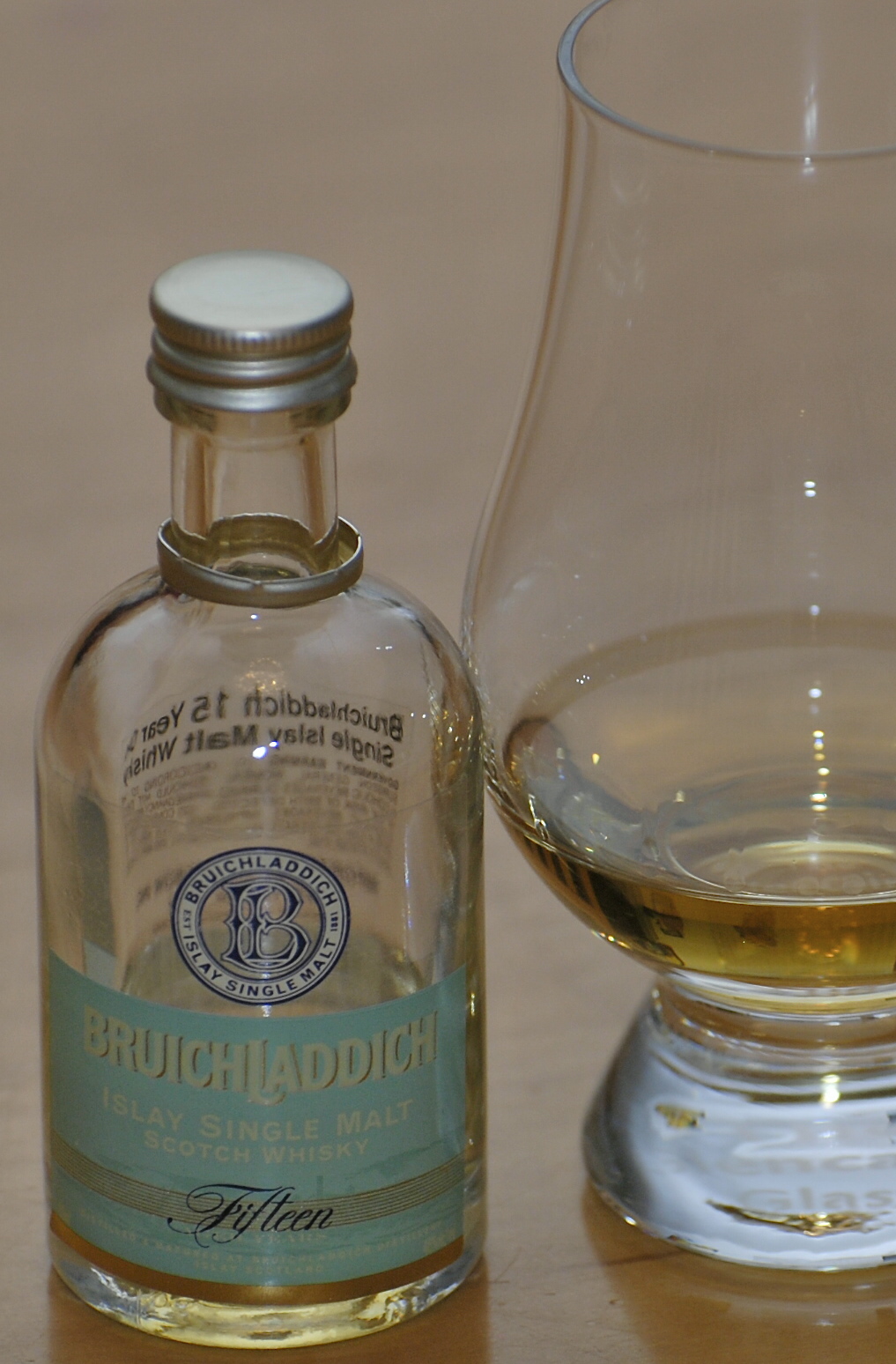
A pour from a Bruichladdich 15 mini

A pour from a Bruichladdich 15 mini

I was at my local liquor store, and I mentioned to an employee that I had never tried Bruichladdich [brook-laddie].  He pointed me to the 15 year and talked about how it was finished in Sauternes wine casks.  Then he mentioned that they just got some 50 ml miniatures of it in stock.  Cool, a chance to try it without full commitment!  At home, I was reading the tiny print on the bottle and canister, looking for mention of the casks.  I couldn’t find any. The bottle did state that this whisky is bottled at 46%, and the canister points out that that it’s not chill-filtered or artificially colored. Sounds good so far.

Looking online, I discovered that the Bruichladdich 15 year “Second Edition” is the one that is finished in Sauternes casks.  What I had in my hand was a miniature of the first edition Bruichladdich 15.  This one is a vatting of 85% whisky from American Oak casks, and 15% from Spanish Oak casks.  I’m guessing they got a pretty good deal on these from the distributer.  I checked back at the store the next day, and it is indeed the Second Edition full size bottle that they have in stock (it says Second Edition on the bottle).  Oh well, it’s still a chance for me to get my first taste of a Bruichladdich.  Let’s take this outdated mini for a spin…

Tasting notes

On the nose, I’m getting some light winey notes (white wine, not sherry), and a lemon, floral mix.  Something else is there that I want to call a pine scent.  Not real pine, necessarily, but the artificial pine scent you might find in air fresheners or cleaners. If I leave my nose in the glass a while, I feel like there is some vanilla as well.

On the palate, it reminds me of semi-sweet melon, and then some peppery spice comes through.  It’s pretty light weight, though.  The finish?  Not much of one…the pepper lingers for a very short period, and it seems a little salty.  Then it all quickly disappears.

Conclusion: I’ve read the distillery notes, and a couple of reviews now, and they mention a “fresh” scent/taste with the Bruichladdich 15.  I don’t know what “fresh” tastes or smells like, though.  Is it that pine scent I was picking up?  To me, this malt is very ordinary.  The nose is Ok, but doesn’t really pull me in.  It’s very easy on the palate; nothing offensive there, but then it’s quickly gone and forgotten.  It IS very drinkable.  I could move right through quite a few ml of this stuff without really thinking about it.  It’s just not something I want to sit with in the evening and savor. I find it very average.

At $40, I think this would be a great daily drinker, or perhaps something light and easy on a summer afternoon.  However, at the current price of $85 (if you can find it), I just don’t see it.  At that price, I’m going to turn to a number of other single malts before this one.  I’m not in any way turned off of Bruichladdich, and I’m curious about their peated offerings, I’m just not going to extend myself to get a bottle.

Other opinions (and distillery info)

I wasn’t able to find a whole lot of information on this first edition of the 15 year.  A number of the reviews I found were for the second edition. Here are a couple of links, though:

  • Whisky Magazine – Notes and ratings by Michael Jackson and Dave Broom.  There are also links to some forum threads on this expression further down the page.
  • Royal Mile Whiskies – Not for sale anymore, but there are some tasting notes.
  • Bruichladdich Product Sheet (PDF) – A link to the company product sheet for Bruichladdich 15.

Bruichladdich Distillery location

Read Full Post »

Introduction

Margy McCoy (@MargyMcCoy), a Friends of Laphroaig employee, sent out a request on Twitter earlier today asking others to tweet about their first experience with Laphroaig.  She’s offering up a bottle of Feis Ile Cardais scotch to the best tweet.  I was immediately taken back to my first sip of Laphroaig 10 and responded with this tweet:  “My first @LaphroaigWhisky (10) shocked my system. Is that tar?! smoke? Palate intrigued, left brain wary. My palate won out.

Obviously, I’m not going to win that little contest.  However, that’s honestly how I felt.  I was totally confused by what I was experiencing on the palate, and my brain was telling me that I shouldn’t be liking what I was tasting.  Margy’s tweet made me want to look up my original notes, and I decided to go ahead and post them here for laughs.  I need to try Laphroaig 10 again, now that I’ve had quite a bit more experience with Islay malts (including Laph. 15 and QC, which I love).  I’m sure my notes will differ quite a bit.

How about you?  If you like drinking Islay single malts, was it love at first taste?  Did you “get it” the first time, or was it something you had to work your way into?

Original Tasting Notes

Here are the notes I jotted down after drinking Laphroaig 10 (my first Islay malt) for the first time.  This was on January 9th, 2009, and I had only tried a few whiskies prior to this.  I was familiar with light, earthy peat from Talisker, but this was a whole new ball game:

NOSE

  • Smell of some smoke, but not overwhelming
  • Sweet peat smell
  • A little bit of “tar”

TASTE

  • Holy crap!  This completely shocked my system.  If I were to imagine what it would taste like to run out and lick the street right after it’s been paved, this is it.
  • I taste nothing but tar.  My mouth is overwhelmed.
  • Not bitter, though.  I have no problem swishing it around in my mouth, and it goes down easily enough.
  • There’s a bit of a viscous, oily quality not present in the other scotches I’ve had.

AFTERTASTE

  • Still tar, tar, tar
  • Wait…finally something else.  Oily exhaust fumes, like sitting on a bumper boat, surrounded by other bumper boats in an enclosed area, with some oil burning off and dripping into the water.  Or maybe that’s just more tar.

CONCLUSION

Ok, so I wasn’t ready for this.  I don’t think I made any “bitter beer” faces, though, and I kept drinking it.  If there’s more to the taste, I never recovered from my first impressions of “I can’t believe I’m drinking tar” to discover it.  I enjoyed the nose, actually.  I still can’t believe how different the taste was from the nose.  My mind is saying that I shouldn’t enjoy this, and that it belongs in a blended or vatted scotch.  However, I remain curious about what I’m tasting.  I think i’ll try again sometime, being more prepared going in. Maybe I’ll have a different experience and pick out more flavors.

Flash Forward

Four and a half months later (5/29/09), I just had Laphroaig 10 again, at the same bar as the first time.  Since that first taste, I’ve had many other Islay expressions, including Laphroaig QC and 15, and Islay malts have become my whisky of choice (Lagavulin and Caol Ila at the top).  I went to the bar tonight with some friends from work, assuming that I would have a significantly different take on this scotch.  I was surprised to discover that my reaction hasn’t changed all that much.  It’s still an extremely tarry, medicinal dram, and not all that complex.  I can’t believe how different the 10 year is from the 15 year, or even the Quarter Cask.  The biggest differences this time around were that 1) it didn’t shock my system, and 2) I was comfortable with the fact that I like it.

I have Laphroaig 10 cs Batch 1 (Feb 2009) and  Laphroaig 12 Cardais samples on the way.  Maybe I’ll get a 50ml of Laphroaig 10 as well, so that I can compare the range in a controlled environment and take better notes on the 10.  In the mean time, I’ll sum up my feelings on the 10 year by saying that I could drink Laphroaig 15 or QC every day, while the 10 year would be an every now and then change-up.  Relative to other core Islay expressions, I find both the Ardbeg 10 and the Caol Ila 12 more interesting and pleasing to my palate.

Read Full Post »

Introduction

A pour of Port Askaig 17

A pour of Port Askaig 17

Tonight, we have the Port Askaig Islay 17 year single malt scotch, bottled at 45.8% ABV, non-chill filtered, and no added coloring.  Port Askaig is a new range of single malts from Specialty Drinks Ltd (SDL), a sister company of The Whisky Exchange (TWE). Along with the 17 year, they offer a No Age Statement (NAS) cask strength, and a 25 year. Apparently, they’re also going to introduce a limited release 30 year expression later this year. This range was just introduced in late April, 2009, but is already getting a lot of buzz around the online whisky community. I think I have more links in my “Other Opinions” section on this post than for any other scotch I’ve blogged about.

One of the things that’s interesting about this range is that they haven’t disclosed which distillery the whisky actually comes from. Current consensus on the internet seems to be Caol Ila. More about this later in my post. Port Askaig 17 is available from TWE for 50 GBP (current equivalent: $75). I believe it’s also available through select importers in other European countries, but it’s not currently exported to the United States.

Tasting Notes

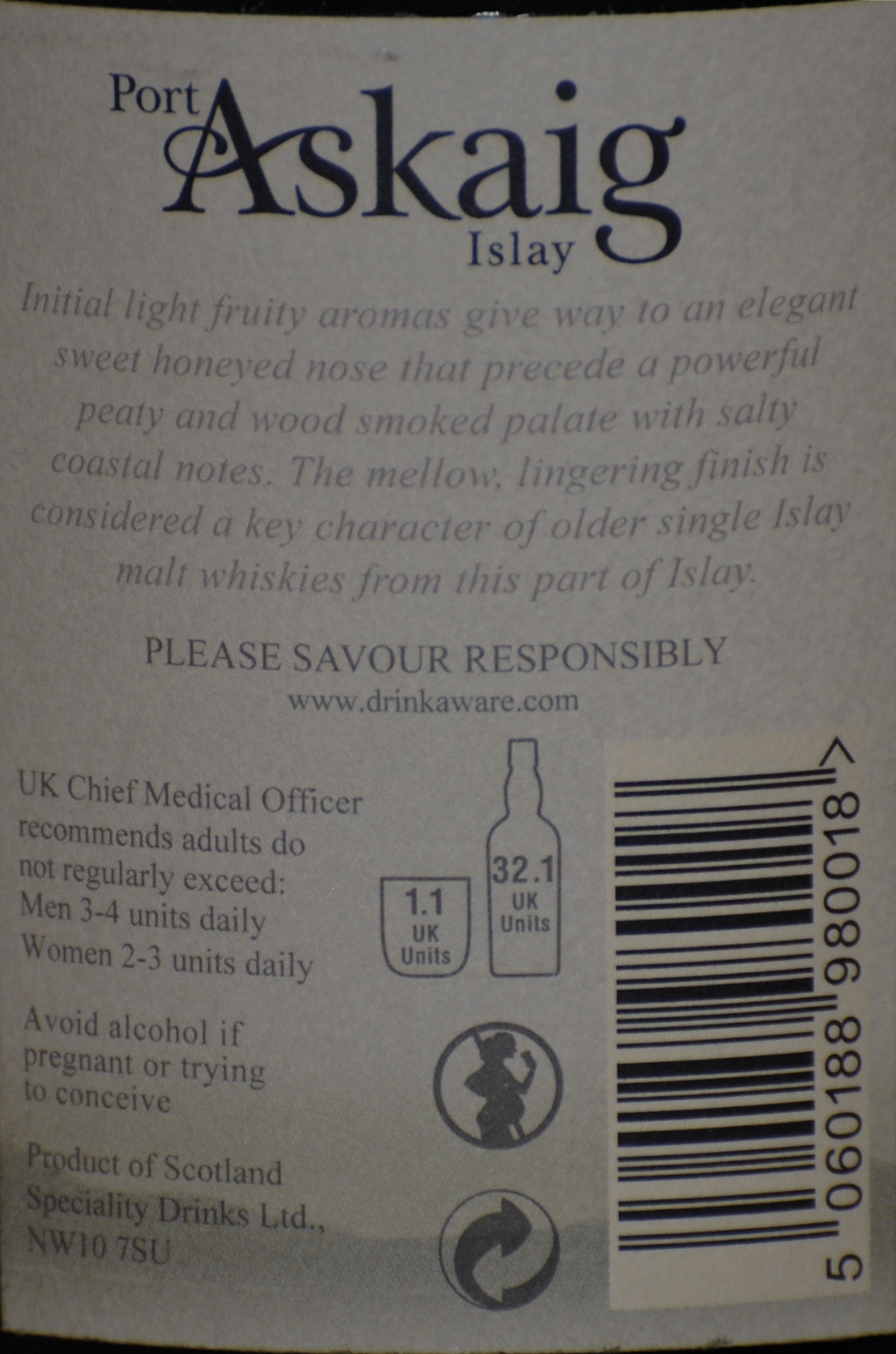
Port Askaig 17 Back Label

Tasting notes on the bottle

On the nose, the Port Askaig 17 immediately reminds of Caol Ila. That honey-sweet citrus right up front, with peat that isn’t quite as tarry as Ardbeg or Laphroaig, or as medicinal as Lagavulin. However, as I spent some more time taking in the aroma, I noticed that the citrus seemed different than the Caol Ila 12 or 18 original bottlings (OBs).  With CI, I get a very strong citrus zest. The PA seems to take a little of that zesty edge off, like you’re just getting the inner fruit. With even a little more time and imagination, the citrus started to turn to apple, like I get with Ardbeg. Perhaps, also, that honey sweetness is a little deeper than CI, again more along the lines of Ardbeg. The last bit of “Ardbeg” that I’m picking up is a hint of “art store”…the aisle where they have the ink and pencils. Very interesting. I like this nose a little better than the CI 12 or 18.

On the palate, I’m again immediately reminded of Caol Ila. The citrus and sweet peat are still there from the nose. It’s a tiny bit “hot” on the tongue, but in a good way, not a rough/cheap way. As it works its way towards the back of my tongue, some pepper starts to come on, building into the finish and slowly dying down. Also coming on with the finish is the Caol Ila coal smoke, and the earthy peat continues to linger. There are no bad after-tastes, and it goes down with a pleasant warming. My glass is emptying rather quickly.

Conclusion: This is a very enjoyable dram. I think it’s a step up from the Caol Ila 12, Ardbeg 10 and Laphroaig 10 standard bottlings. Then again, so is the price. Port Askaig 17 strikes me very much as a bridge between Caol Ila and Ardbeg, which I think is a positive thing. It makes me want to try experimenting with my own vatting of CI 12 and Ardbeg 10. I’m going to put this close to (but after a head-to-head comparison, a little below) the Laphroaig 15 as one of my favorite whiskies so far, with Talisker 18 and Lagavulin 16/DE above that.  If you’re an Islay scotch lover, you really should try to get your hands on this. If you’re a big Ardbeg fan, but Caol Ila not so much, I think you should still try this out. You might be surprised. If you’re in the U.S., the shipping cost makes it a little less cut-and-dry, as the Caol Ila 12 (Edit: or the Signatory 14 I’ve now tried) gets you pretty close to PA 17 for a lot less money.

Update (head-to-head): The above notes were done without directly comparing the PA 17 with Caol Ila and Ardbeg. It’s a couple of nights later, and I decided to pour small drams of Caol Ila 12, Port Askaig 17, Ardbeg 10, and Ardbeg Uigeadail. So, any change of heart from what I stated above? A little bit. I said that I felt the citrus “zest” from Caol Ila was rounded off a little on the PA, but I’m not so sure about that. I’m getting that lemon zest this time. I also felt that the PA was much more clearly in the Caol Ila camp with this hands-on comparison.  My bottom line here is that Port Askaig 17 is what I think Caol Ila 18 should be. I would gladly pay the additional $7.50 at TWE for this over the CI 18.

Update 2 [6/4/09]: I’ve got samples of the PA 25 and Cask Strength on the way, so I’ll be able to compare the whole range. Woo hoo!

A Caol Ila by any other name…

Nobody from Specialty Drinks Ltd and/or The Whisky Exchange has come right out and stated that Port Askaig whisky is distilled by Caol Ila, and industry insiders that have probably been clued in seem to be playing along, just offering clues. Not convinced that Port Askaig is really Caol Ila?  Let’s take a look at the evidence:

  1. The name: Port Askaig is located on the East side of Islay, a short ferry ride from Jura.  If you look at a distillery map of Islay, you’ll see that Caol Ila is located right in Port Askaig, with Bunnahabhain just a little bit north of the Caol Ila location.  The rest of the distilleries are much further to the South or West.
  2. The ages of the expressions: The NAS Cask Strength, 17 year, and 25 year expressions sure line up nicely against other common bottlings of Caol Ila, both by the original distiller (OB) and independent bottlers (IB). I mean really, how easy would it be for Specialty Drinks to come up with a bunch of 17 and 25 year (and don’t forget the 30 year later on) casks of Ardbeg?  Ardbeg can’t even seem to get 17 and 25 year casks of Ardbeg.
  3. Port Askaig 17 Bottle Seal

    Port Askaig 17 Bottle Seal

    Geographic Coordinates on Bottle: Printed on the seal of the bottle is the following coordinates:  N. 55:50:41 W. 06:06:10, which converts to Lat. 55.8447, Lon. -6.1028 in decimal. I saw this and thought perhaps this would be a clue. If it’s from another distillery, would they potentially provide a Latitude/Longitude that doesn’t match the actual Port Askaig location? However, punching in the  numbers in Google Maps puts you right in Port Askaig, just a bit south of the Caol Ila distillery.

  4. Taste profile: While I could potentially be fooled in a blind test into believing PA 17 is an Ardbeg, the overall profile is certainly in line with the OB Caol Ilas I’ve tasted. Don’t take my word for it, though. The many tasting notes in the “Other Opinions” section below (by people with much more tasting experience than me) show a strong similarity to the Caol Ila profile.
  5. Clues from industry insiders: Check out the Malt Advocate blog post and comments, linked in the “Other Opinions…” section below.
  6. I know somebody who knows somebody…: I got a tweet (Twitter post) from @whiskyfan who says that  “according to @hansemalt the German importer verified that Port Askaig is Caol Ila.”  So there you go…I know somebody who knows somebody who knows somebody with inside information.

Other Opinions

  • The Whisky Exchange Blog – Tim F. writes about the new Port Askaig releases, and provides his own tasting notes for the 17 year.
  • Malt Advocate Blog (What does John know?) – John Hansell provides notes and ratings for both the 17 and 25 year expressions.  He really likes the 17 year.
  • Edinburgh Whisky Blog – Notes and ratings personifications by Lucas of both the 17 and 25 year expressions.  More extremely positive feedback.
  • Caskstrength.net – More notes and discussion about the 17 and 25 year expressions, and more of a “statement” than a guess that this is from the Caol Ila distillery.
  • Spirit of Islay (once it’s archived, this will be the link) – In the May “A Whiff of Peat Smoke…” newsletter, Gordon shares his notes on the 17 and 25 year expressions. There is also a discussion in Gordon’s Warehouse No. 4 forums.
  • Whisky, Whisky, Whisky – Tasting notes on the Port Askaig 17 year. Making me feel much better about myself, Mark also noted a similarity to the Ardbeg profile. There’s also some additional discussion in the WhiskyWhiskyWhisky forums, kicked off by none other than Tim F. from TWE.
  • YouTube – Ralfy (from ralfy.com) has now reviewed the PA 17 on his video blog. Quite entertaining…check it out: [Added July 10, ’09]

Read Full Post »

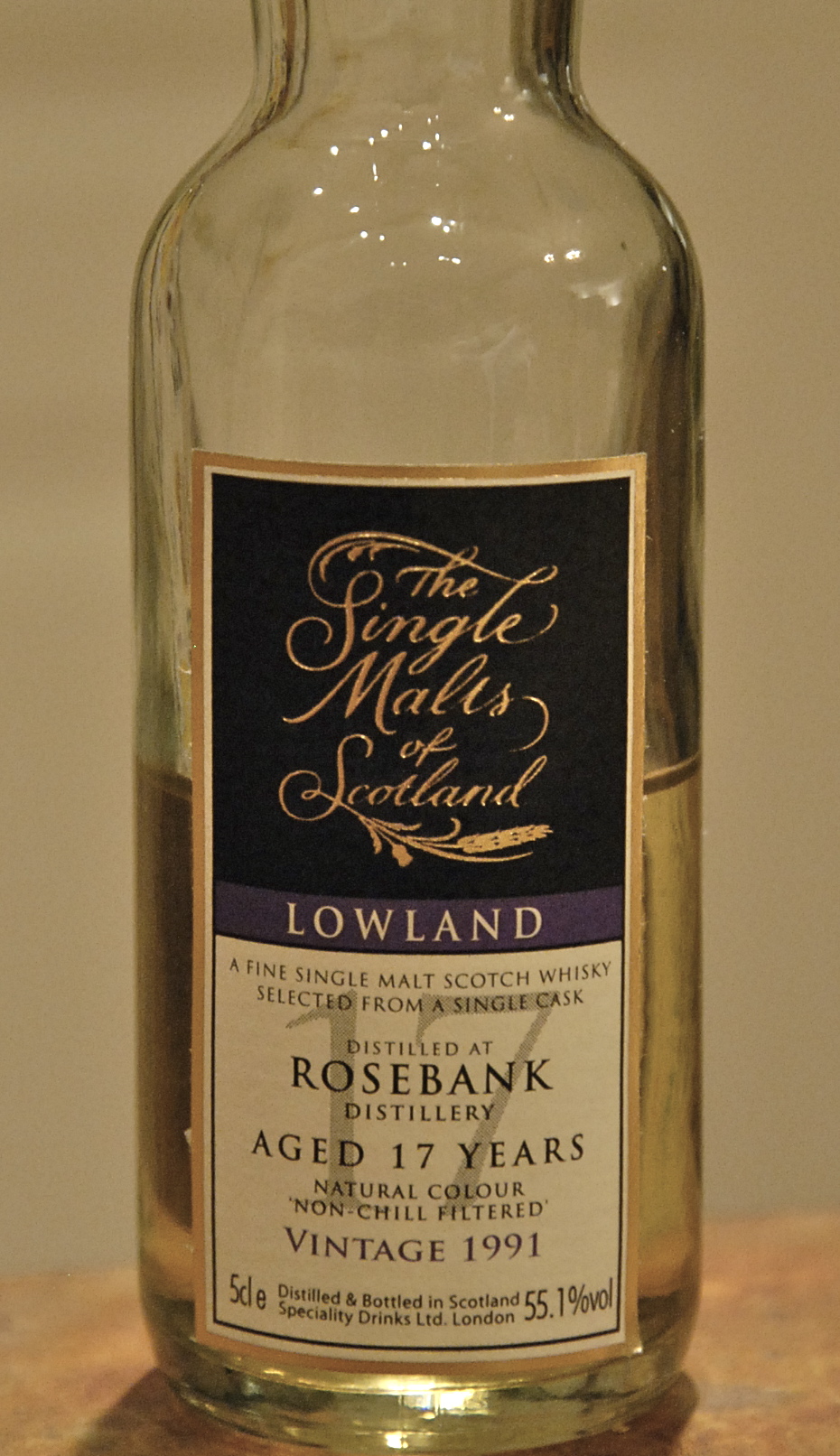
Rosebank 1991, 17 yr. (Single Malts of Scotland)

Rosebank 1991, 17 year (SMS)

Introduction

Of the closed distilleries in Scotland, Rosebank, a lowland distillery, doesn’t have quite the buzz of a Brora or Port Ellen.  There does, however, seem to be a fairly widespread opinion in the whisky community that it’s a shame Rosebank isn’t still in operation.  Fortunately for us, they appear to have had a pretty good stock on hand when they closed.  A “Rosebank” search on The Whisky Exchange web site currently turns up 18 results, with 10 expressions from various bottlers available for under $100.  The focus of this post is a 50 ml sample of Rosebank 17 year, 1991 vintage, bottled at 55.1% ABV from The Single Malts of Scotland (Specialty Drinks Ltd.), a sister company of The Whisky Exchange.  This particular expression is non-chill filtered and has no additional coloring added, and it’s bottled from a single cask.

Tasting

On the nose, this Rosebank is light and very fruity (citrus). There is some light honey sweetness as well. The nose is actually kind of muted, even compared to other “light” drams I’ve had recently such as the Yamazaki 12.  On the other hand, you can stick your nose right in there and the alcohol doesn’t really get in the way, which surprised me given that this is cask strength.

On the palate, the strong citrus continues, as does the sweetness. However, the sweetness evolves from honey to, I want to say, butterscotch. There is a bit of alcohol “hotness”, due to the ABV, but it’s not harsh at all. I rather liked it…just a gentle kick in the pants to make sure you’re awake. Then, out of nowhere, pepper becomes very noticeable on the palate, and continues to linger through the medium to long finish. I didn’t see this coming, as I wasn’t really picking up much in the way of spices on the nose. Also surprising to me was the body, which seemed pretty oily and full. I really liked this combination of light flavors and full body.

Conclusion – This is a very accessible drink, even at the full 55.1% ABV. Not only that, I tried adding some water and it retained all of the primary characteristics, just losing that initial hotness on the palate.  I’ve only tried one other lowland expression, and that was Auchentoshan Three Wood.  I consider this a significant step up from that dram. I also consider this a good jump from some other light profile Speyside scotches such as Glenfiddich 15 Solera Reserve.  The only thing keeping it from my top tier of scotches is the muted nose, and I suppose there’s room for additional complexity, but I still rate this highly just for the pure enjoyment factor.

I currently have a bit of an Islay bias, and while I feel inclined to collect just about every peaty whisky I can find, I feel a bit differently about other types of whisky. I’m content (at the moment) to just have one or two solid examples of each profile on hand. For example, Aberlour a’bunadh can satisfy me when I get the itch for a “sherry bomb” Speyside. Likewise, I think this Rosebank is great for when I get the urge for a lighter, non-sherried Speyside or Lowland scotch.

Is it worth nearly $100? That’s a personal choice, of course.  I think it probably is, given that 1) it’s a single-cask expression at full strength, 2) it’s from a closed distillery that’s well thought of, and 3) it tastes really, really good. I am, however, curious about the Gordon & MacPhail 1991 Rosebank that goes for 2/3 the price of this SMS expression (although it is bottled at 43% ABV). Could that give me 95% of the enjoyment of this SMS bottling at 65% of the price? Too bad they don’t offer a 50 ml mini of that one (that I’ve seen) for comparison.

Update: After doing a post on Port Askaig 17 and experiencing the strong lemon citrus there, I wanted to revisit the Rosebank 17. The citrus I get here is definitely NOT a strong zesty lemon like I get with Caol Ila and Port Askaig. It’s more of a candied orange. The other thing I noticed upon revisiting the Rosebank is that there is something floral going on here, and I’m surprised i didn’t mention that the first time around. Still a very enjoyable light profile dram, with a cask-strength kick.

Other opinions (and Rosebank info)

  • Whisky Fun – Here’s a link to their Rosebank summary page, with links to all of the expressions they’ve tried.  They don’t have notes on this specific expression, but they do have notes on other SMS 1991 vintage Rosebanks, with a particularly good review of the 16 year that was bottled 6 months before this 17 year.
  • The Whisky Exchange – A link to their page for the full size bottle of this expression.  It includes tasting notes from Tim F, who does their blog. [Note – Is it Ok for me to include a link directly to an online alcohol retailer?]
  • Malt Madness – Rosebank distillery profile, trivia, and review summaries.
  • Whisky Party – Ok, one of the guys over at Whisky Party has now had the opportunity to try the same miniature from TWE, and provides a different view point (he’s not particularly thrilled with this bottling).  I don’t expect everybody to react the same to every expression, and my experience with lowland scotch is pretty limited, so I’d encourage you to check out his review.  Then go buy yourself a miniature of this Rosebank and let us know what you think! [Added 6/3/09]

Read Full Post »

Lagavulin 12 Natural Cask Strength 2007

Lagavulin 12 Natural Cask Strength 2007

Introduction

Tonight [well, last night by the time I post this] I’m drinking from a 20 cl bottle of Lagavulin 12 ‘Special Release’, another sample from my 2007 Classic Islay Collection gift pack.  I posted yesterday about the value of these gift packs because of the inclusion of the Port Ellen Annual Release.  However, this Lagavulin makes for another very compelling case, as it appears to be hard to find in full size bottle form.  At this time, both Royal Mile Whiskies and The Whisky Exchange are sold out of the 2006 and 2007 releases of Lagavulin 12.  This particular expression is bottled at a natural cask strength of 57.1%.  Like the Port Ellen, this 20 cl bottling is at a different strength than the full size Lagavulin 12, which is bottled at 56.4%.  I’d still like to hear from somebody who might know the reason for this difference in bottling strength. [Update – Tim F from The Whisky Exchange kindly shared a response directly from Diageo in the comments.  Thanks Tim!]

Tasting notes

On the nose, neat, the Laga 12 is all Islay, with peat, coal smoke, something medicinal in nature, and just a hint of the fruity sweetness found in the 16 year old.  On the palate, there’s an in-your-face brashness (not to be confused with harshness).  This is an energetic drink, exploding in the mouth with that 57.1% ABV heat and tons of peat, along with some pepper spiciness and then drying on the tongue.  Heading into the finish, it’s very drying on the tongue.  There’s more of that peaty coal smoke, and it lasts for quite a while.  Adding a little water, the nose now hints at more of the sweetness you expect from the Lagavulin 16 year, but it is still much more muted.  The alcohol heat is gone, the pepper is subdued, but the peat remains.  A little of the sweetness now makes its way into the palate in the form of light citrus.  The finish remains very similar to the way it was neat.

Conclusion – Tomorrow I might pull out the Laga 16, put on Miles Davis’ Kind of Blue, and contemplate life. Tonight, I’m just going to crank up some Metallica Master of Puppets and enjoy the rest of this Lagavulin 12 ‘Special Release’.  It’s what I have imagined a Caol Ila cask strength would taste like.  The first time I tried the Lagavulin 12, I drank it along with the 16 year and found myself comparing them.  I think the additional richness of the 16 masked the strengths of the 12.  That’s not really a fair thing for me to do, as I’m prone to perhaps an unjustified glorification of  Lagavulin 16 and Talisker 18 single malts.  I consider them nectars of the gods, categorized separately from beverages intended for mere mortals.  Of the earth-bound whiskies, I put this cask strength 12 year right up there at the top.  It’s a take no prisoners peat train crossing the island of Islay, with smoke from the coal-stoked engine hitting you in the face.  It’s not hugely complex, but it’s not one-dimensional either, and what it has to offer is all good.  There’s nothing offensive going on here at all.  I highly recommend trying Lagavulin 12 if you like Islay scotch, even if you find Lagavulin 16 slightly overbearing.

Other opinions

  • WhiskyFun.com – Tasting 5 young Lagavulins.  Here’s a comparison of 4 Lagavulin 12 special releases, along with an independent bottling.  They felt the 2007 bottling was a big improvement over the 2005 and earlier bottlings.
  • Whisky Magazine – The tasting notes and scoring are for an earlier release, but you will also find links to a number of forum threads about Lagavulin 12, and discussions comparing the 12 and 16 profiles.

Read Full Post »

Introduction

Port Ellen 7th (28 year) in sample bottle

Port Ellen 7th (28 year) in sample bottle

A couple of months ago, I started becoming aware of the buzz around the Port Ellen Annual Releases, and became very interested in this whisky. However, I was pretty sure I would never actually taste a Port Ellen original distillery bottling (OB).  I mean really, $400 for a 750ml bottle? No way that’s happening for me right now.  Then I discovered Diageo’s Classic Islay Collection gift pack.  It’s a box containing five 200 ml bottles (Caol Ila 12, Caol Ila 18, Lagavulin 12, Lagavulin 16, and Port Ellen 7th), and you can get it for around $100 through The Whisky Exchange [Link to my post on this gift pack].

Suddenly, a Port Ellen purchase became much easier to justify. So, here I am with a dram of the Port Ellen 28 year “Seventh Release” (2007) in a Glencairn tasting glass. Life is good. [The picture might look odd. I decided to set aside 100ml of my PE 7th for future use. I poured my 200ml bottle into two 100ml sample bottles, steamed off the label, and stuck it on the sample that I’m saving.]

I’d like to point out that this is a cask-strength bottling of Port Ellen whisky, coming in at 54.7% ABV. Let me also point out that if you buy a full size bottle of this same release, you will find it bottled at a slightly lower 53.8%. I’m not sure why the difference between the two, but I’d love to hear about it if you know.

Update – Tim F from The Whisky Exchange provided the following explanation in the comments section of my Lagavulin 12 post (Thanks Tim!):

Okay, I found the email reply I received from a source close to Diageo when I asked about the different bottling strengths. The following as verbatim from his email:

“…the different bottlings of the same issue (i.e. the 70cl and the 20cl bottles) were filled on different dates and possibly even at different bottling lines. The actual ABV of the spirit can vary a few degrees depending on how and when the different casks (even those from the same year) are vatted together before bottling; and the actual strength is measured precisely on the bottling line and the labels adjusted to reflect the precise measurement, I think.”

So it seems likely that the difference in strengths stems from a delay between the bottlings of the 20cl and 70cl after the batch had been made up. This does make some sort of sense, I suppose.

Tasting

On the nose, my first thought is that this is similar to Caol Ila. There’s a similar fruity sweetness combined with peat and light smoke. But there’s more with this Port Ellen…a rich vanilla scent that now brings Laphroaig 15 to mind. So, we have a complex nose here, but it’s also a little bit muted. I feel inclined to take a bigger whiff, only to then be hit with the high alcohol content (which didn’t stand out to me on normal nosing).

On the palate, it’s not muted at all. There’s a significant presence, kind of “hot” from the cask strength, but also very peaty. On the back of the palate and starting into the finish, I’m again reminded of Caol Ila. This time, it’s coal smoke. However, once again, the Port Ellen continues to deliver where Caol Ila drops off. The finish lasts longer, with a distinct earthy peat (Talisker-like) coming up through the back of the nostrils.

I tried adding a little water, but didn’t take much in the way of notes. I’ll talk more about the effects of water in another post, when I compare the PE 7th with the PE 6th release. The water did seem to take away some of the vanilla on the nose, bringing it back closer to Caol Ila. It also removed the hotness on the palate, but left the peat in tact.

Conclusion

This is a really nice scotch in its own right. The fact that it’s from a highly respected and closed distillery, and is something of a rarity, makes the experience all the more enjoyable. I always find myself trying to associate new [to me] whiskies with ones that I’m already familiar with. In this case, I didn’t have to try very hard to imagine a vatting of Caol Ila 12 and Laphroaig 15, bottled at cask strength. Maybe throw in a little Talisker 18 on the late finish. My interpretation of these associations (to three scotches that I love) is that this is a complex dram that hits on all of the right notes for my tastes. On the other hand, I did find myself wishing the nose was a little less muted. It seems like I have to try harder while nosing this one. At this time, I can’t say whether I prefer it with or without water, but I’ll revisit that in the future.

If you can afford to buy the full size bottle, or if you can get your hands on The Classic Islay Collection like I did, I highly recommend trying this excellent scotch whisky. It slots nicely into the gift pack lineup, somewhere between the Caol Ila and Lagavulin in terms of flavor profile, and shares traits [and level of complexity] with Laphroaig 15. If this was more readily available and you could pick up a 750 ml bottle for closer to $100, I would be all over this as a regular purchase to keep available in my house. At the current price [for a full size bottle], I think you have to be able to appreciate the Port Ellen story/history to get your money’s worth.

Additional Information

  • Info about the Port Ellen distillery
    • Malt Madness Distillery Data – Malt Madness is a sister site to Whisky Fun, and they have great information about most of the distilleries in Scotland.  This is a link to their Port Ellen page.
    • Islay Web Log – Here’s an extract from the book “Port Ellen Distillery and Maltings” by John A Thomson.  While the Port Ellen distillery was dismantled long ago, you still here a lot about “Port Ellen malt”.  This article gives some background on the creation of Port Ellen Maltings, built to supply malt to the Port Ellen, Caol Ila, and Lagavulin distilleries in the early 1970s.
  • Other opinions on the 7th Annual Release
    • WhiskyFun.com – Here’s a comparison of three Port Ellens, including the 7th release.  They really like this one a lot, scoring it 92 points (vs. 86 points for the 3rd annual release).
    • John Hansell – An early “What does John know?” blog post, with tasting notes and scoring for the 7th release.  90 points.
    • Whisky and other wonderful things – A blog by somebody with much more scotch drinking experience than I have.  He’s not nearly as impressed, finding this release a bit too one dimensional.  7 (leaning towards 6) points out of 10.

Read Full Post »

Introduction

A pour of Ledaig 10

A pour of Ledaig 10

Last night I spent some time with the Ledaig 10 years scotch.  Ledaig [led-chig] scotch whisky is distilled on the Island of Mull at the Tobermory distillery.  Ledaig uses a peated malt (peated to 35-40 ppm?), while Tobermory whisky uses unpeated malt (although there is apparently peat in the water source).  I purchased this bottle locally for $43, which puts it in the same range as whiskies like Laphroaig 10, Bunnahabhain 12, Clynelish 14, Glenfarclass 12, and Macallan Cask Strength.  The Ledaig wasn’t really on my radar, but I saw the video review of this from PeatLuvr on YouTube (link below) and decided I wanted to try it.  [Weird – The small image to the right looks much greener on my screen than the full size image when you click on it]

Tasting notes

My first impression upon putting the glass to my nose is of rubber (sulphur?), like when you’re standing in a tire store.  It’s a pungent smell that makes me want to pull away immediately.  Now, if I go back four or five times for additional sniffs, I seem to be able to get past that first impression.  The rubber starts turning to egg, and there’s a sweetness with it, along with lemon zest.  There’s also definitely a very present peat component.  However, if I put the glass down for a little bit and come back to it…Boom, there’s that pungent rubber again.  I’ve had this a few times and it takes me a while to get used to the nose each time.

On the palate, things pick up for me.  Strong peat (this is what I bought it for), along with a peppery heat.  That’s better.  On the finish, that pepper sticks on the tongue a bit, but there’s also some alcohol burn.  This one really seems young and temperamental both on the nose and finish.  I also get a little bit of that rubber again coming up through the nostrils with the peat at the end.

Conclusion – I’m a little mixed on this one.  I think there’s something about the output from the Tobermory distillery that doesn’t quite sit right with me.  I’ve tried a Tobermory before as well, and thought there was something slightly “off”, maybe a bit sulphury again.  It’s not a total loss, as I do enjoy the peat/pepper explosion on the palate.  For general drinking of this bottle, I think I’m going to relegate it to tumblers and not spend much time nosing it.  I also need to try adding a little water to see how that changes it.  I’ll drink this bottle, but don’t have any plans to purchase another any time soon.  There are a lot of other peaty malts out there that I enjoy more.

Other opinions

  • Whisky Magazine – Dave Broom and Arthur Motley provide their impressions and scores.  Neither one of them mentions rubber or sulphur, although Arthur does talk about the sweet egg smell.
  • Whisky Pages – Some info on the distillery, as well as tasting notes and rating.  These guys seem pretty positive on the Ledaig 10, not mentioning any particular negatives.  They give it a fairly average score, though.
  • YouTube (PeatLuver) – Tom really likes it, and doesn’t seem to take any offense to the pungent nose.  Where I get rubber/sulphur, then sweet egg product, he gets “fruity”.  Maybe I just have a mental block based on my first impression (tire store).

Read Full Post »

Introduction

A pour of Laphroaig 15

A pour of Laphroaig 15

43% ABV?  Bzzzt…wrong answer!  Non-chill filtering? Bzzzt…not here. This Laphroaig 15 year is obviously not with it, as all of the cool kids these days are bottled at 46% abv or higher, and non-chill filtering is all the rage.  It’s only fitting that the Laphroaig [la-froyg] 15 is being replaced by a non-chill filtered 18 year old at 48% abv.  Good riddance, right?  Not so fast…this expression still has a few tricks up its sleeve.  Last night I spent considerable time with a large dram of the Laphroaig 15, and will share my experience here, as well as link to some other resources on the internet.

A note on price: Laphroaig 15 is very reasonably priced here in Arizona. The two main big box liquor stores here are charging $55 and $64 for a 750ml bottle. I understand that the 18 is going to be priced somewhere closer to $100. Certainly something to consider if you run into a bottle of the 15 and are debating whether to pick one up.

Tasting

On the nose, the first impression is tarry peat smoke sweet fruit (cinammon apples [and pears]).  A little longer on the nose and I’m getting vanilla. The peat is there, but it’s not a strong tar and phenol experience like I got when I tried the 10 year (which I need to revisit now that I have more Islay experience). The peat is also very integrated with the other scents. [Update] Bananas! I hadn’t noticed it before, but having just done comparisons between Laph 15 and the 10 CS and 2009 Cairdeas, I’m definitely getting bananas on the 15 year.

On the palate, the sweetness fades quickly, replaced by spices and peat. It’s fairly oily and full bodied as well. I don’t think the 43% abv is a problem here. It’s not until the finish that the tar smoke comes through, rising up through the nostrils with some oak. There is also a drying sensation on the tongue. There is lots of stuff going on here, providing a rich sensory experience.

Conclusion: I mentioned in the Whisky Mag. forums that I like this scotch better each time I try it. This continues to be true, and I now rank it right up there close to Lagavulin 16 (I said “close”, not equal) in terms of the full cycle of nose to palate to finish. I can nose it all night long and it doesn’t get old. There’s also no alcohol roughness getting in the way at any stage of the experience. To maximize your enjoyment of this particular expression, I recommend leaving your preconceptions of a “proper Laphroaig” at the door, and considering the 15 on its own merits. Don’t compare it to the Laph. 10 CS on the same evening (well, not every time, anyway), as I’m sure this one will suddenly seem too light-bodied, or lacking in phenols.

If you like Islay malts, and you haven’t tried this yet, I’m begging you to grab a bottle if you can find one. Even if it turns out to be your least favorite Laphroaig, I can’t imagine that you’ll actually dislike it, and you might love it. Get it while you still can…

Other opinions

Here are some links to other reviews and notes on Laphroaig 15:

  • Whisky Magazine:  Tasting notes and ratings from none other than Michael Jackson and Jim Murray.  MJ rated it very highly, while JM found some faults.  Scroll down for links to a number of discussions on Laphroaig 15, including comparisons to other Laphroaig expressions.
  • WhiskyFun.com:  Notes and ratings on a number of Laphroaigs circa 2006.  The 15 did very well here as well, scoring 90 along with the 30 year expression.
  • Whisky For Everyone:  Another whisky blog that I enjoy reading…some good information about Laphroaig in general, plus notes on the 15 year.
  • Whisky Party:  A comparison of the 15 year to Quarter Cask.  They also recommend grabbing some 15 year while you can, finding it a bit more complex than the QC. [Update 6/5/09]
  • Laphroaig 15 on YouTube:  Check out the PeatLuvr and IslayScotchWhisky reviews, then watch Ralphy partake of some Laph. 15 from the top of Merrick Summit in Scotland.

Distillery location:

Read Full Post »

I’ve been sitting on a 50ml miniature of Bowmore 18 for a while.  This past week, I finally purchased a bottle of Bowmore 12, so I decided to go ahead and compare these two expressions for my “nightly dram” last night.  The 12 is bottled at 40% ABV, while the 18 is bottled at 43%.  Interestingly, the 12 years miniature is bottled at 43%.  [What’s up with that?  It seems like false advertising.]  Anyway, I’m going to compare the 40% and 43% 12 year at a later time.  For this sitting, I wanted to get a feel for how the 12 and 18 compare in their regular bottling expressions.

Bowmore 12 and 18 comparison

Bowmore 12 and 18 comparison

Availability and pricing here in AZ

There is quite a jump in price here in AZ from the lower Bowmore expressions to the higher ones.  Here’s the progression:  Legend = $22-$28; Bowmore 12 = $38-$46; Bowmore 15 Darkest = $70; Bowmore 18 = $95.  I picked up the 12 hoping that, at $38, it would become my go-to low to mid-priced Islay dram.  I suppose I should have started with the Legend, but I’m looking for something with enough maturity to compete with Caol Ila 12 (which costs $50-$60 locally).

Tasting

Bowmore 12

On the nose, there’s really nice earthy peat and light smoke right up front.  It’s also a little sweet, but more fruity than toffee.  As I persist, something else pops in there…it reminds me of a flavored hot tea.  [Update 5/25/09: Upon revisiting Bowmore 12, I think the “flavored tea” is actually more of an interplay between the smoke and a passion fruit scent.  The first time around, when I couldn’t place it, it kind of turned me off.  Now I don’t mind it so much.]

On the palate and finish, I get the earthy peat coming through loud and clear, which I really like.  There’s a little sweetness on the palate, but not much at all.  The body seems a little light, almost watery.  I’m going to have to compare this to the 43% mini I have.  On the finish, I really like the continued peat and smoke, but it’s slightly masked by kind of a dusty sensation.  That “hot tea” thing is coming back as well, in the form of a slight bitterness that sticks around after the peat and smoke dies off.  To be honest, this is a slight turn off to me.

Bowmore 18

On the nose, I think the 18 offers pretty much the same profile, but it’s stronger, with quite a bit more fruit.  I’m not getting that “hot tea” thing as much with this one.  Just peat, smoke and mixed fruit.

On the palate, again you can tell this is in the same family as the 12.  However, there’s more body.  Additionally, there’s some spice in the form of a peppery grip on the tongue.  It’s not as strong as a talisker, but it’s there, and I like it.

Summary

Overall, I thought these were perfectly nice single malts, and worth a try.  I used to think of Talisker as a “gateway” to Islay, but now I’m thinking you don’t need a gateway.  If you want to get an idea of what peat and smoke are like, but don’t want to get overpowered, go right for the Bowmore 12, and it won’t cost a lot.  It’s actually tamer than the Talisker 10 and 18, as it doesn’t have the strong pepper finish that those offer.  The peat and smoke in the Bowmore is also very Talisker-like…there’s none of the tar and coal like you get from Ardbeg, Laphroaig or Caol Ila.  I like the Bowmore 18 better than the 12, with the extra body and spiciness on the palate.  However, at $38 vs. $95, I’m having a difficult time with the Bowmore 18 price point.  For now, I’ll be happy to finish the Bowmore 12, but I’ll stick with Caol Ila 12 and Ardbeg 10 as my main, mid-priced Islay malts.  I am, however, curious about the Legend at $22 as an entry-level Islay scotch.

Related links

  • Whisky Magazine – Bowmore 12 review:  tasting notes and scores from Michael Jackson and Dave Broom (they really like it).  Dave Broom mentions a “lavender-tinged smoke”.  I wonder if that’s the “hot tea” flavor I’m talking about.  Scroll down for links to Whisky Mag. forum posts about this expression.
  • WhiskyFun.com – Check out this comparison of all four of the latest Bowmore OB expressions.  They kind of panned the 18 year old, which surprised me.  This is a great site, btw…scroll to the top of their page and check out the side bar on the left to get links to the various distilleries, then browse all of their articles/ratings for that distillery’s expressions (OB and IB).
  • Whisky For Everyone – Another whisky blog that I follow.  Here is some general information about Bowmore, followed by notes on the 12 year.
  • YouTube Videos – Both PeatLuvr and IslayScotchWhisky have done videos on Bowmore 12.  You might want to also check out the IslayScotchWhisky review of the Bowmore Legend for comparison with the 12.

Read Full Post »

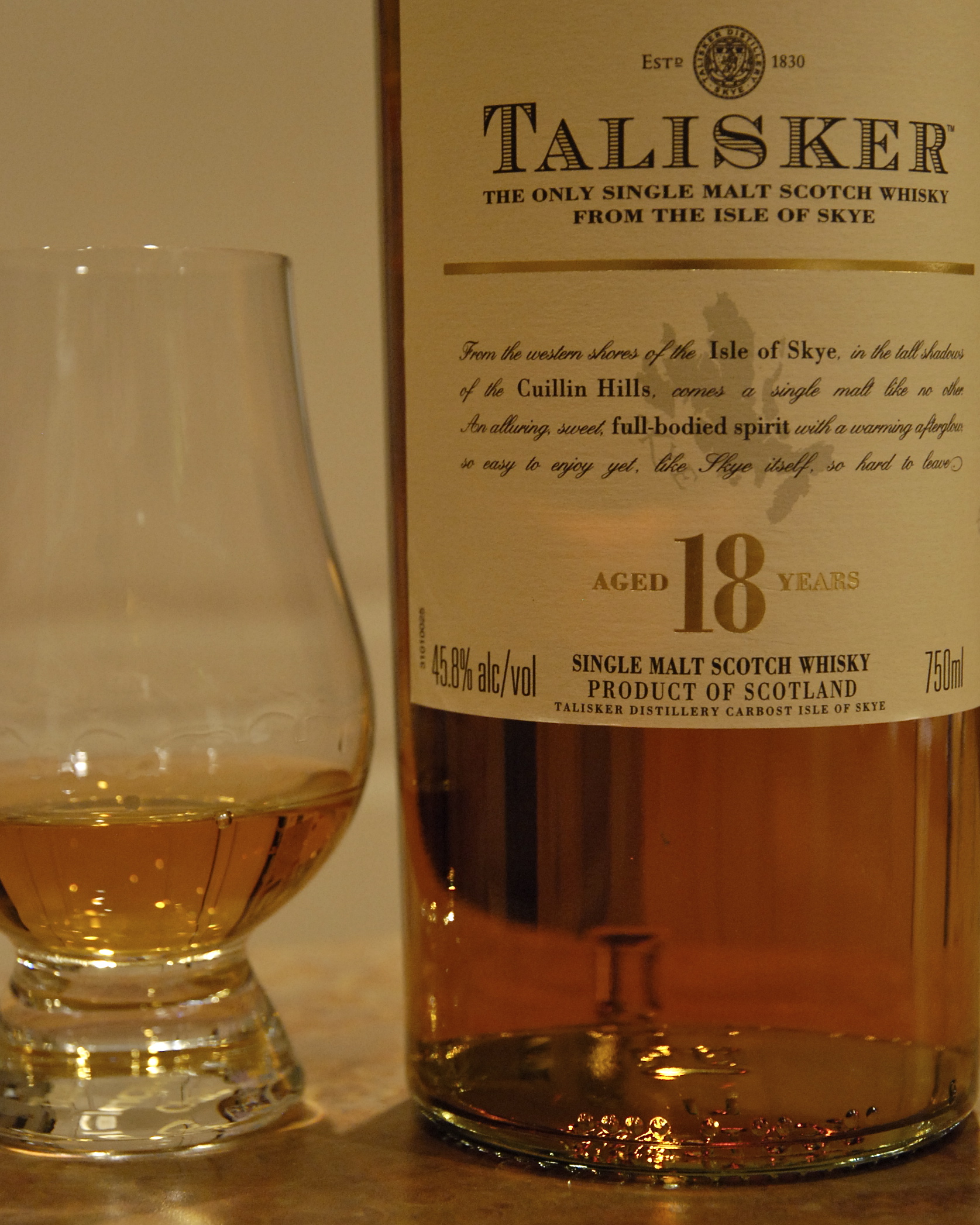
Talisker 18

Talisker 18

Ahh…that’s the stuff.  If you’re looking for a fair and balanced Talisker 18 review, look elsewhere (perhaps some of the links at the bottom of this post).  I have nothing negative to say about this wonderful scotch whisky.  In fact, the first time I tasted it, I immediately declared it better than all of the other scotches I’d tasted.  Although, at the time (just four months ago), that count stood at around 8.  I’ve tried a lot more whiskies since then, scotch and others, and I’ve since given up trying to declare a single “best” one.  I’ve gone with more of a tier system, and Talisker 18 remains in the top tier along with Lagavulin 16 and DE, Highland Park 18, and perhaps The Glenlivet 18.

On the nose, I get an earthy peat and light smoke, something slightly medicinal, and finally just a bit of toffee sweetness.  Once in the mouth, the sweetness becomes more fruity, and then a slight peppery sensation grows stronger in the back of the mouth as the drink goes down.  Finally, coming up through the back of the nose at the end is that earthy peat and smoke again.  I can’t believe how balanced this scotch is.  Those main elements of peat, smoke, iodine, sweetness and pepper come and go in waves, dancing together in harmony like…  Oh crap.  I’m starting to wax poetic over my freaking drink.  Ok…climbing back down to earth here:  This scotch whisky rocks!

Apparently, I’m not the only one that puts the Talisker 18 way up there relative to other whiskies.  It won the “Worlds Best Single Malt Whisky” award in the 2007 World Whiskies Awards, for whatever that’s worth.  This whisky is bottled at 45.8%, and I’ve purchased it in two configurations:  200ml as part of a gift pack containing the 10, 18 and DE Taliskers (highly recommended, and I’ll talk about this in another post) – $65; 750ml bottle – $70 to $80.  Currently, the Talisker 18 has gotten very difficult to find locally in AZ.  No new stock appears to be coming in.  Luckily I have a couple of additional bottles stocked up for future use.

Check out these additional tasting notes and resources for Talisker 18:

  • Whisky Magazine – Notes and ratings by Martine Nouet and Dave Broom, as well as links to WM Forum threads, including comparisons of the 10 year to the 18.
  • The Whisky Exchange – In addition to being able to buy it here, you can see the stats and additional tasting notes.
  • K&L Wine Merchants – Located in CA, selling it for $76.  The reason I’m posting the link here is so you can check out their description.  They’re saying that the 18 is “almost out of existance”.  I emailed them about it and they replied that this is what their sales rep said.  It seems to be readily available overseas, and the distillery web site doesn’t say anything about it going away, so I’m not sure what to make of that.
  • Malts.com – Tasting notes on the 18 and other Talisker varieties from the Diageo Classic Malts web site.  [This doesn’t seem to be the most reliable web server in the world].
  • Distillery location [Carbost, Isle of Skye, UK] in Google Maps:

Read Full Post »

« Newer Posts - Older Posts »