Feeds:
Posts
Comments

Introduction

Brora 30 2009

I’m tasting the Brora 30 Year 2009 Special Release from Diageo via another 30 ml sample from whiskysamples.eu. I’ve been holding onto this sample for a few months until I got around to purchasing a bottle of Clynelish 14. Having seen other people refer to this 2009 release as being more Clynelish-like than previous 30 year old Broras, I wanted to see what that means. I have tried one other Brora before…a 21 year from Signatory. I like it, but don’t love it. Therefore, I’ve not been quite as anxious to get my hands on a Brora special release as I have been for the likes of Port Ellen, Talisker and Lagavulin. However, having now tried this expression, I realize that I SHOULD have been more anxious to try it.

Tasting Notes

Brora 30 Year (2009 Release); OB; 53.2%; 2652 Bottles

Nose: My very first impression is of butterscotch. With some time, it turns into a rich vanilla with oak and smoke. Also some mint. Possibly some fruit trying to break through, bringing peaches and creme to mind. Maybe I just “want” there to be fruit, though. A tiny bit farmy and medicinal during my comparisons to other malts.
Palate: A great mouth coating. Very rich, yet gentle. I’m easily brought back to butterscotch here…with some peat and a late pepper entry. With more than this small sample to try, and additional tasting sessions, I could imagine the butterscotch coming across as juicy ripe fruits.
Finish: Probably my favorite part of this one. The sweets and oak from the nose come back (oak more prominent than on the nose), but the light smoke is now clearly peaty. An earthy peat reminiscent of Talisker, but dialed way down.

Comments:

What a wonderful whisky, showing obvious maturity and tons of subtle complexity. The rich butterscotch/vanilla and well controlled oak remind me of the Cragganmore 40 year I bought a while back (G&M Secret Stills 2.2). I’ve heard tales of oak taking over and ruining “old” whiskies, but that’s certainly not a problem here. I would love to have a bottle of the Brora 30 to pour a glass from at night and sit with over a long period, listening to classic jazz. Easily worth 90/91 points if I had more than a 30 ml sample to base my opinion on, so I’ll go with an A- letter rating.

Value:

I can’t fault the $400 price tag, as that’s not unusual for a 30 year ongoing releases, let alone one from a closed distillery like Brora. However, as good as this is, if I could pick just one 30 year old in this price range, it would be a stronger offering from the likes of Talisker or Lapharoaig. While the subtle peat in the Brora is exactly the kind I like, I felt like it was teasing me…urging me to seek out that characteristic in a fuller form. Of course, this is an entirely personal reaction.

Comparisons

I got a generous sample of a Signatory Brora 21 year from a friend a while back, and it surprised me with strong mint (as if mint has been infused into the whisky) and a sharp farmy quality. Comparing it side-by-side with this 30 year release, the 21 year isn’t nearly as sophisticated. I wonder if I would have noticed the light mint on the 30 year if I had never tasted this 21 year variant. Some folks would most likely prefer the more in your face nature of the Signatory 21 to the subtle charms of the Brora 30. If it was the peat that was turned up, I might bite, but with the mint and farmy qualities, I’m in the more subtle Brora 30 camp.

I also compared to Clynelish 14 (Clynelish being the active sister distillery to Brora). There certainly seem to be similarities in the underlying spirit. While the Brora struck me with butterscotch first, possibly turning to fruit later, the Clynelish seemed more fruity up front, but I could imagine some butterscotch there. I get a little bit of mint in the Clynelish as well. Clynelish has a little smoke, but lacks the earthy, Talisker-like peat that I got from the Brora (at least in side-by-side comparison). It’s no competition for the Brora 30, but the Clynelish is very nice for the price. I think a slight increase in peating level would do it wonders.

Other Opinions

The guys that actually know what they’re talking about are saying this is a less “farmy” Brora than previous 30 year special releases. For me, this one has just the right amount of that particular trait. It sounds like the 2008 25 year and this 30 year are the ones for me (if I suddenly come into some money). Although, I’d love to taste one of the old, more peaty Brora releases (distilled in the early ’70s?).

  • Whiskyfun – 91 points from Serge. More Clynelish and less Brora than previous bottlings, he says, but still excellent.
  • Malt Advocate – John Hansell really digs this one, and comments on how well it holds up for its age. 93 points!
  • WhiskyNotes – Just when I was wondering if the mint was all in my head, good ‘ol Ruben came through with a similar interpretation. 90 points, which means a lot coming from him!
  • Whisky For Everyone – Tasted along side the other Diageo Special Releases, Matt and Karen also noted a butterscotch-like sweetness and really enjoyed this expression.
  • caskstrength.net – Tasted along side the Talisker special releases, they went the citrus route, over my interpretation of butterscotch. Also stating that Springbank lovers should enjoy this Brora.
  • The Whisky Exchange Blog – Perhaps a little closer to my butterscotch…here we get condensed milk and tinned pears. Tim prefers this year’s Brora over last year’s 25 year and the 2007 30 year.
  • Whisky Whisky Whisky – Over on the W3 forums, butephoto praised the Brora 30. It sounds like he might have had a 30 ml sample like mine.

Introduction

A pour of HP 'Earl magnus'

Cool people might drink whisky, but drinking whisky does not make you cool. If you want to see what the cool kids think of HP Earl Magnus, check out WhiskyFun.com or WHISKYhost.com and get their take on this new special release from Highland Park. In this blog post, I will share my initial impressions of this 15 year, 52.6% special release, then I’m going to hit you with more pictures and packaging details than most self-respecting whisky drinkers would care to see. Basically, it’s a post for [geeks] whisky fanatics like me. This isn’t a full “review”, as I like to spend several tasting sessions establishing my thoughts on profile, and evaluating overall satisfaction level. For more background on the Earl Magnus release, check out this previous blog post.

Opening the bottle in true geek fashion

Having decided to go ahead and open my bottle of Magnus alone, rather than wait for a get-together with fellow whisky drinkers, I still wanted to spice up the experience. I mean come on, the packaging for this thing is SO Glen Wonka, it almost makes you feel guilty to be a drinker rather than a collector.

Ever since I saw the beautiful box that Earl Magnus is packaged in (pictures below), I had visions of the monolith and accompanying music at the beginning of 2001: A Space Odyssey [I know, the Glenmorangie Signet box is the one that actually looks like a monolith]. So it seemed appropriate to play Also sprach Zarathustra (Richard Strauss) in the background while I unlatched the box, took out the bottle, removed the wax seal and popped the cork. Here, try it for yourself and see what you think:

Tasting Notes

Highland Park Earl Magnus Edition One;  15 Years; 52.6%

This expression is matured primarily in American Oak sherry casks, with a few Spanish sherry casks thrown in to create the right amount of sweetness (from HP via Twitter).

Nose: Take the honey from the standard 12 year and dial it up. Now take the 15 year profile and dial the citrus way down. Add a very rich, creme brule vanilla and a sprinkle of cinnamon and you have the HP Earl Magnus nose. Contrary to Gerry Tosh’s comments in this video, I don’t find that the high alcohol volume ratcheted up the smoke. There’s a soft peat smoke, but it isn’t nearly as smoky as the high proof older expressions (21, 25 and 30 year).
Palate: Ahh…there’s the citrus from the standard 15 year. A very juicy palate, but where is all of that alcohol? It doesn’t burn the tongue at all.
Finish: Pow! Here’s the big pay-off for Earl Magnus. Right as you swallow, your whole tongue starts drying, and it’s enhanced by a wonderful peppery spice. Citrus and smoke fumes fill the mouth cavity and loft up into the nostrils. It lasts for a pretty long time. I think the alcohol volume is just right. It’s a party in the mouth, but stops short of burning.

Comments: Well, I suppose I DID build it up a bit much, what with taking a ton of pictures and opening the bottle to music. However, it came pretty close to living up to such over-hype. I’m very satisfied with this whisky so far, and the combined taste and presentation make the $120 (shipped) I paid seem very reasonable. It fits very nicely between the standard 18 and 21 year bottlings in value. I look forward to spending more time with this bottle, but right now, I’d say it’s right on the B+/A- border in my scoring system (see the side bar).

Comparisons

I did do some brief comparisons with the standard 12, 15, 18, and 21 year, as well as a Scott’s Selection 25 year. It was interesting how, when nosed side-by-side, all of the other expressions seemed slightly farmy relative to the Magnus. It was in these comparisons that the honey and vanilla became even richer (reminiscent of The Balvenie Madeira Cask), and the sprinkle of cinnamon came through in the Earl Magnus. The Smoke on the 21 year and Scott’s 25 year was much more obvious, both on the nose and the finish.

Having worked my way through most of my standard HP 15 year 43% bottle, and doing this comparison, I’ve come to the inclusion that my original rating of 88 for the standard bottling was a point too high. There’s definitely a bit more separation between that one and the 18 and older expressions, as well as this Magnus special edition.

Pictures and Packaging Details (with info about the this release)

Click on any of the pictures to see them full sized.

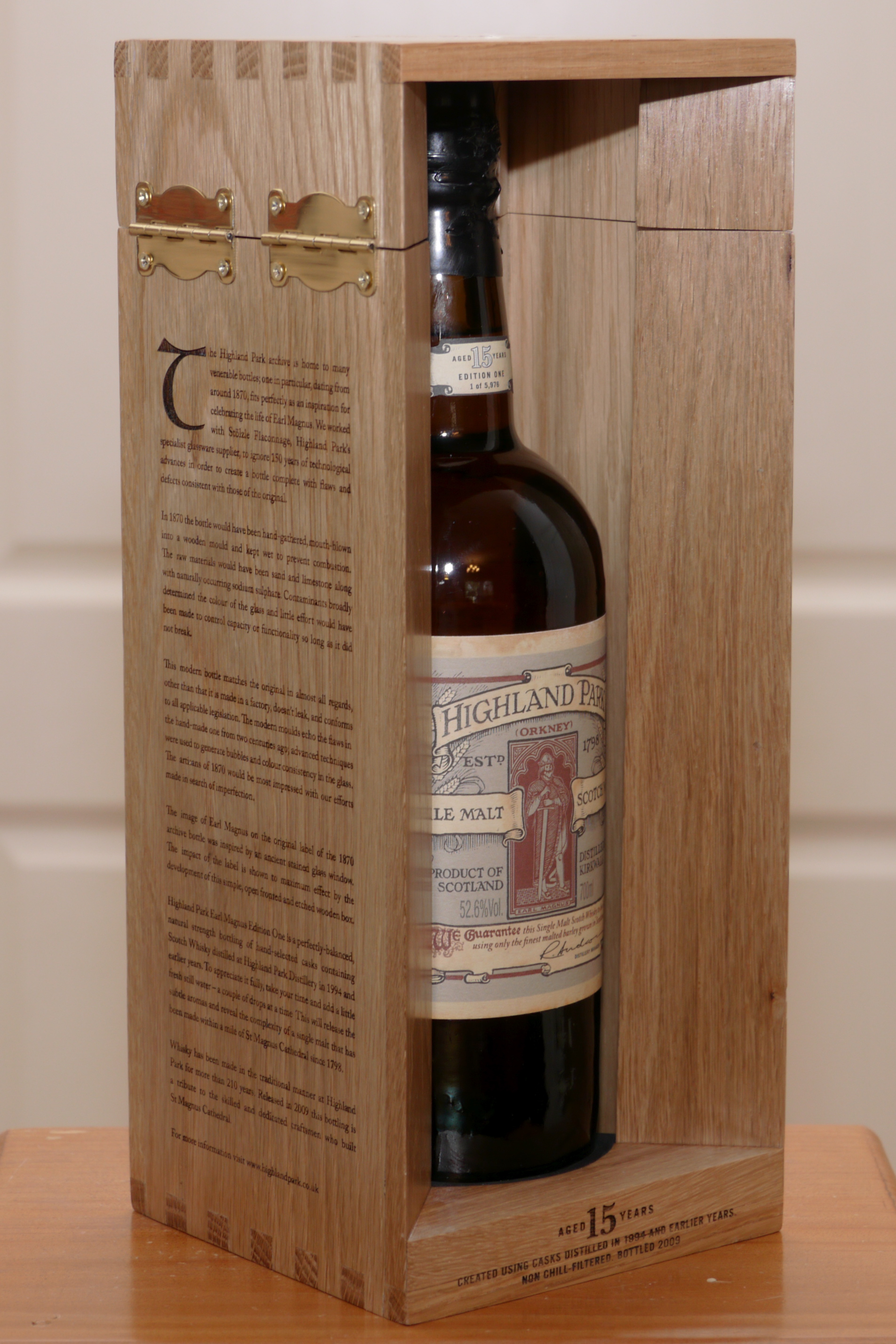
  • The old-fashioned bottle making process results in an imperfect stance.

Leaning tower of Magnus

  • Left side of the box, with brass hinges and info about the bottling:

Magnus Box Left

The Highland Park archive is home to many venerable bottles; one in particular, dating from around 1870, fits perfectly as an inspiration for celebrating the life of Earl Magnus. We worked with Stolzle Flaconnage, Highland Park’s specialist glassware supplier, to ignore 150 years of technological advances in order to create a bottle complete with flaws and defects consistent with those of the original.

In 1870 the bottle would have been hand-gathered, mouth-blown into a wooden mould and kept wet to prevent combustion. The raw materials would have been sand and limestone along with naturally occurring sodium sulphate. Contaminants broadly determined the colour of the glass and a little effort would have been made to control capacity or functionality so long as it did not break.

This modern bottle matches the original in almost all regards other than that it is made in a factory, doesn’t leak, and conforms to all applicable legislation. The modern moulds echo the flaws in the hand-made one from two centuries ago; advanced techniques were used to generate bubbles and colour consistency in the glass. The artisans of 1870 would be most impressed with our efforts made in search of imperfection.

The image of Earl Magnus on the original label of the 1870 archive bottle was inspired by an ancient stained glass window. The impact of the label is shown to maximum effect by the development of this simple, open fronted and etched wooden box.

Highland Park Earl Magnus Edition One is a perfectly-balanced natural strength bottling of hand-selected casks containing Scotch Whisky distilled at Highland Park Distillery in 1994 and earlier years. To appreciate it fully, take your time and add a little fresh still water – a couple of drops at a time. This will release the subtle aromas and reveal the complexity of a single malt that has been made within a mile of St. Magnus Cathedral since 1798.

Whisky has been made in the traditional manner at Highland Park for more than 210 years. Released in 2009 this bottling is a tribute to the skilled and dedicated craftsmen who built the St. Magnus Cathedral.

For more information visit http://www.highlandpark.co.uk

  • Right side of box, with brass latch and information about Earl Magnus:

Magnus Box Right

Earl Magnus Erlendsson was born in 1075 when the Orkney Islands belonged to Norway. His Viking ancestors were terrifying warriors whose code of heroism, hatred and honour through vengeance framed their brutal lives. Into this world came Magnus, a man unlike any other Orkney Earl, spreading Christianity.

The pease-loving Magnus was unlike his cousin Haakon who remained imbued with the fighting spirit. Haakon was envious and ambitious, striving for self-glory. Their history is a classic tale of the struggle of good versus evil; the treachery and tragedy of the life of Earl Magnus accounts for his prominence in northern literature.

Magnus reigned jointly with his cousin Haakon from 1108 until 1115 when their followers fell out. Peace was negotiated and the Earls agreed to meet bringing only two ships each. The treacherous Haakon arrived with eight ships and captured his saintly cousin. The Norwegian chieftains decided that one of the Earls must die. After the refusal of his standard-bearer to undertake the task, Haakon ordered his cook to kill Magnus which he did by striking him on the head with an axe.

The life of Magnus is celebrated in two Icelandic Sagas and in the Orkneyinga Saga; he was buried where he died and legend has it the rocky area around the site immediately became a green field.

The fame of Magnus, canonized only 20 years after his death, has been maintained by the stunning cathedral built by his nephew in Kirkwall; St Magnus Cathedral was referred to as ‘incontestably the most glorious monument of the Norwegian dominion to be found in Scotland’ by J. Moodie Heddle, Orkney and Shetland, 1920.

Work began in 1137 and continued over several hundred years. In 1917 a secret cavity was found in one of the columns; in it was a box containing ancient bones including an axe-wounded skull. The influence of Earl Magnus spread far and wide; the forename became popular in Orkney, notably in the case of Magnus Eunson, a man forever associated with the founding of Highland Park distillery in 1798.

  • Back of bottle, with raised logo and wording:

Magnus bottle (back)

  • Highland Park logo on bottle:

Magnus bottle HP logo

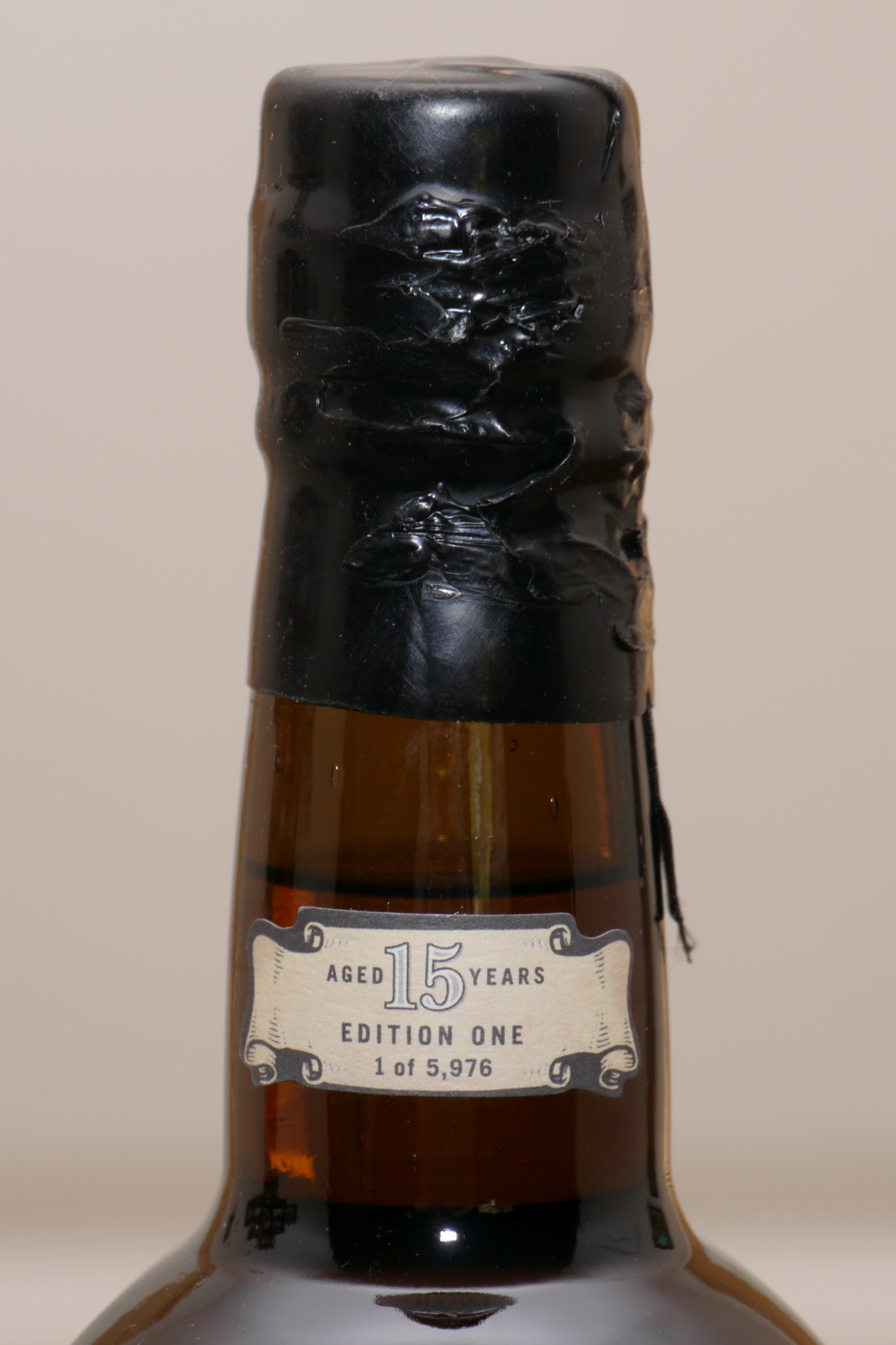
  • Bottle top with wax seal. The ribbon hanging out cuts easily through the wax. Nothing like trying to open one of those freaking Aberlour A’bunadh bottles. 🙂

Magnus bottle top

  • An imperfect bottle surface and concave bottom, mimicking the style created in 1870:

Magnus bottle surface texture

  • Air bubbles in the bottle (upper middle):

Magnus bottle air bubbles

Introduction

Signed Bulleit Btl

As I prepared to leave work yesterday, I checked my Twitter feed and saw the reminder from Sportsman’s Fine Wine and Spirits that a free Bulleit Bourbon tasting was taking place from 5:00 pm to 7:00 pm. I was kind of tired and almost ignored it, but then…I’ve passed that unique flask-shaped bottle with raised lettering many times and wondered about the spirit inside. Why not take a few minutes to see what it’s all about? I’m glad I went, as company founder Tom Bulleit was there talking about bourbon and signing bottles. Not only was he a very entertaining and likable gentleman, but I also got the scoop on some new works in progress by this [currently] single-expression brand!

Tom talks about the Bulleit History

Tom bulleit at Sportsman's in Scottsdale, AZ

It’s Mr. Bulleit’s Great, Great Grandfather Augustus who is credited with formulating the original Bulleit whiskey recipe. He came to America with his French family in 1805, taking root in New Orleans. In the 1825 to 1830 time frame, he worked his way up to Louisville, Kentucky where he married and ran a couple of taverns. He also started making whiskey, which he sold locally, and would also take barrels back to New Orleans to sell there.

Tom Bulleit mentioned that he DID work at a distillery when he was young (he’s currently 67 years young), but his father was never really involved in the business. Tom went on to be a marine and a successful lawyer. However, he had always dreamed of resurrecting the family whiskey recipe and starting his own business. He said his father wasn’t too keen about the idea, but Tom felt compelled to follow his passion. He founded Bulleit and ran it as a family business until 1997, when they partnered with Seagrams. Diageo bought out most of Seagrams a few years later and Bulleit became their small-batch bourbon. He said that Diageo has been great to work for/with. They can still be very entrepreneurial and independent, but have access to vast resources.

The Bulleit Bourbon recipe

Now, the story goes that the Augustus recipe, after his death in 1860, was passed along in the family, and it was this recipe that Tom used when he founded Bulleit Bourbon in 1987. The current Bulleit recipe calls for 68% corn, 4% malted barley, and 28% rye. This is a significant increase in rye relative to other bourbons. What I found interesting was Tom’s description of the original Augustus recipe. He said it was originally about two thirds rye and one third corn…not technically a bourbon by today’s standards.

So…I guess the “original recipe” thing is a bit of a loose interpretation, with the key being that, as a bourbon, it has a very high rye content. Of course there are other factors involved in the recipe. Apparently they are very specific about how the grains should be grown. They also have a method of filtering the distillate so that they’re only using ethyl alcohol and none of the phenols (something to do with temperature and specific gravity…I took his word for it). This helps give it a very smooth character. They mature the barrels for at least six years, at which point they start checking them for “proper” maturity. The barrels used to make the final product are between six and eight years of age.

Tasting Bulleit

Bulleit Bourbon Frontier Whiskey; 45% ABV (90 proof)

Nose: Gentle, with very little direct alcohol influence. Vanilla and some light fresh oak and medium sweetness. Hints of citrus come and go.
Palate: Gentle at first, then a very noticeable pepper spice, almost Talisker-like. Turns dry fairly quickly.
Finish: The pepper has a medium-long duration, and this is VERY drying on the tongue. More vanilla, and just a touch of smoke in the back of the nostrils.

Comments:

I expected the 28% rye content to really give this a pop, but it’s quite gentle. It’s fascinating to experience that pepper and high level of dryness on the tongue, but have the rest of the experience be one of subtle toffee sweetness, vanilla and light oak. Bulleit compares price-wise with Knob Creek and Maker’s Mark. I’m having difficulty organizing their profiles in a linear fashion, though. The Bulleit lies in between the other two in relative sweetness and spiciness, but it’s lighter than either of the other bourbons. That lightness is similar to that of Gentleman Jack Tennessee Whiskey, but unlike the GJ, you can tell this one is whiskey, not flavored water.

My tasting notes are based on the in-store tasting last night, and another dram tonight. I’ll hold off on trying to rate this until I’ve had more experience with it. While I’m not going to give up Island or Islay Scotch for this bourbon, my initial impression is that it is a good value if you can find it for a little over $20. I’ll pull it out when I’m looking for something light, but I still want to get an entertaining tingle on the tongue (both from the dryness and the pepper spice).

Bulleit in cocktails

I can’t really offer much when it comes to bourbon cocktails. I like mine neat or with a few drops of room temperature water. Mr. Bulleit also indicated a preference for drinking whiskey neat or on the rocks. He fully supports everyone’s right to create whatever mixes they see fit, but what truly gives him pleasure is seeing somebody enjoy the profile that they worked so hard to create. He did offer up one particular cocktail recommendation. He said this ONLY works with Bulleit [with a sly smile on his face]:

  • A shot of Bulleit Bourbon
  • 1.5 – 2 oz tonic
  • A squeeze of lemon

That’s it…very simple, but he says it’s great. I’ll have to pull a lemon off of our tree this weekend and give it a try.

Conclusion

Signed Bulleit Btl (back)

It was a pleasure meeting Tom Bulleit, and he was incredibly generous with his time. I had monopolized a bit of that time towards the end of the tasting, and when I apologized, he said no apologies necessary. It was a pleasure to talk bourbon with people who are passionate about whiskey. I believed him. He’s a good salesman, but he also seems very humble, down to earth, and appreciative of his opportunity to follow his passion and share it with others. His bourbon is well crafted, refined, and very drinkable. If you’re scared off by the likes of Knob Creek, don’t be frightened by the “Frontier Whiskey” on the label. I’d think of that as more of a reference to Augustus Bulleit’s travels between Tennessee and New Orleans (with whiskey in tow) than to the character of the bourbon itself.

Oh, and I mentioned at the beginning that I got the scoop on some exciting new products they’re working on. However, when I mentioned that I have a whisk(e)y blog, he asked me to hold off putting anything in writing so that they can have first crack at sharing the news. However, I’m free to blog about it in four months if they haven’t gone public with anything. At least that gives you an idea of the time frame they’re looking at. We’re not talking about something that’s years away from coming to fruition.

Introduction

Penderyn Welsh Whisky

What do they know about making whisky in Wales? Quite a bit, apparently. Check out this awesome Penderyn Distillery Visit blog post over at Whisky for Everyone, based on their recent tour. This isn’t just a copycat operation Penderyn has going…they’ve come up with their own unique whisky-making process, from the mash used to the unique combination pot/column still used for distillation. In this Malt Advocate blog post from October, 2008, Ed Minning of Penderyn stated that the average age (at that time) of Penderyn was 4.75 to 5.5 years, with eventual “peak” maturation to take place in 6.5 to 7 years.

Disclaimer: The bottle I’m reviewing here is another freebie, but it was NOT sent to me specifically for review. I just happened to win one of the many contests that Penderyn has held on their Facebook page. Actually, I might have been the first contest winner, after which they changed their contest rules to UK-only participants because of difficulties in shipping alcohol to the United States. Many thanks to the folks at Penderyn for jumping through the necessary hoops to get my bottle to me, though.

How did I win it? Well, one of the people I follow on Twitter recommended following Penderyn there. I did so, and the first tweet I saw from them said that there was 5 minutes left in their contest to win a 700ml bottle of Penderyn. Just complete the following sentence: “I thought Penderyn was just another whisky until…” I quickly followed the link to their Facebook page and entered:

I thought Penderyn was just another whisky until I tasted this charmer with its sweet, fruity, spicy balance. A perfect example of the Scottish heritage that…What? It’s Welsh?! I must go there.”

I certainly didn’t expect to win anything, but thought somebody might find it amusing. To my surprise, whoever was picking the winner really did have a sense of humor and selected my entry!

Tasting Notes

Penderyn Aur Cymru NAS; 46%; Bottled Nov. 2009

This is the standard Penderyn [pronunciation] expression, finished in Madeira casks. The label says “Aur Cymru”, which means Welsh Gold. It’s a NAS (No Age Statement) whisky, but based on the Malt Advocate link in the intro, I’m guessing it’s at least 5 1/2 years old.

Nose: Sweet and fruity, leaning to the tropical side with fruits like mango, grape, green apples and melon. The first time I tried it, the melon especially stood out. Straight out of the bottle, it’s a bit sharp, and there’s some fresh oakiness, but both of these traits die down with time in the glass, with the oak turning to vanilla.
Palate: Because of the initial sharpness on the nose, I prepared for some roughness on the palate, but it was surprisingly gentle. There is a slow developing bitterness, but it’s not very strong. As I swallow, the initial sharpness from the nose seems to playfully reach up and grab my uvula.
Finish: Melon floats up through the back of the nostrils. On the tongue, there’s a sweet bitterness like you get from orange marmalade. The finish is relatively short, but it’s longer than the likes of Chivas Regal or Glenfiddich 12 year scotches.

Comments:

I talk about tropical fruits, especially mango and melons, because that’s the closest I’ve been able to come so far to describing a particular part of Penderyn profile. It doesn’t quite tell the whole story, though. There’s some other element, maybe grassy or floral, that plays a part in making this a totally unique whisky relative to the others I’ve tried. I know they talk about Penderyn maturing quickly, but I’d definitely be interested in tasting an older expression in the future, as this still feels a tad on the young side.

I like this Penderyn, but for me, it’s a mood whisky. Maybe an afternoon or early evening dram when I want something light on the palate, but with a bit of a zing to it. It’s light, but it’s certainly not boring. So, is it a novelty or the real deal? I’d say both! It’s novel, in that it is unique, but I think it has staying power…the real deal.

Rating

  • Score: 81/100 points (B-) [My personal score relative to other whiskies I’ve tried]
  • Bottom line: Light and tropical, with a bitter-sweet finish. A unique whisky likely to evoke mixed reactions. Definitely worth a try to see where you stand.
  • Score higher if: When choosing a Jelly Belly pack, you go for the tropical mix; you prefer marmalade over jam.
  • Score lower if: You’re not looking for something “different” in your whisky; you don’t like sweet whiskies.
  • Value: Penderyn is $60 here in Arizona. I’m a bit torn on the value proposition. I rate this similar to $35-$40 whiskies I’ve tried and liked. However, I understand that this is a relatively small distillery and they probably can’t achieve the economies of scale that a Glenfiddich or Glenlivet can. I really think any whisky lover should try this at least once, though. You could try a 50ml sample to see if you want a full bottle.

Comparisons

Normally in this section, I would talk about other expressions by the same distillery, or whiskies I’ve tried that offer a similar profile. In this case, I have nothing to offer in either of those areas. However, I could compare this Penderyn expression to The Glenlivet 12 year in terms of overall level of enjoyment. The Glenlivet is more gentle on the nose and finish, with a focus on honey and floral notes. It’s VERY drinkable, and would be less divisive than the Penderyn when used as an introductory malt. The Penderyn, with its tropical and bitter-sweet profile, is equally smooth on the palate, but there is a sharpness on the nose and finish that keeps me alert. We’re comparing apples to melons here, but I get similar enjoyment out of both, depending on my mood. I think that’s actually pretty strong praise for the Penderyn.

Other Opinions

I’ve talked about the unique qualities of the Penderyn profile, and that uniqueness seems to lead to quite a difference in opinion by whisky afficianados. I can certainly understand this being a divisive whisky, but I definitely recommend trying for yourself to see where you stand.

  • Whiskyfun.com – A 2004 bottling of Penderyn is one of the few expressions to be completely panned by Serge, coming in at a lowly 45 points. Now, the one he tried was probably closer to a 3 year, so he may like recent bottlings more, but I would be surprised to find him suddenly rating it in the upper 80s or 90s. Note that he also got melons on the finish, likening it to a melon liqueur.
  • Jim Murray (Whisky Bible link) – No direct review link, but I just wanted to point out that Jim Murray LOVES Penderyn. He’s been sampling and rating the releases monthly since 2007, with scores ranging from the mid 80s to the mid 90s, with most being upper 80s and above. The scores have varied from month to month, so it’s not just a progression based on maturation. It sounds like the flavor can vary a bit from batch to batch.
  • Whisky for Everyone – In addition to the link a the top of this post, Whisky for Everyone has posted a full review of the Penderyn Madeira. They mention an herbal grassy note that might not be to everyone’s liking. This is probably the same element of the profile that I was having difficulty describing.
  • whisky-pages – They give the Penderyn a good rating, but feel the Madeira might be masking an underlying immaturity that keeps peeking through.
  • caskstrength.net – A good, but not great review of a Penderyn bottled one year before mine. They admit, though, that they were coming off a string of Islay whiskies before trying this one, which might have influenced their reaction to the lighter profile.
  • Edinburgh Whisky Blog – A comparison/competition between Penderyn and Highland Park 12 back in 2007. The Penderyn came pretty close!
  • Whisky Israel – Gal tries the Penderyn and really likes it. He noticed the oakiness on the nose, and also mentions melons in the profile.
  • Dr Whisky – [Update] Dr. Whisky just added a blog post on this very expression. He finds it to be light and refreshing; an alternative to ordering a round of Jamesons in a bar. Interesting take, given the distinctive flavor in this malt.
  • Drink Hacker – [Update] Another recent review, Drink Hacker also notes the bitter-sweet finish. They find some faults, but give bonus points for “moxie”, with a final rating of B+.

Introduction

The Balvenie 17 Madeira Cask

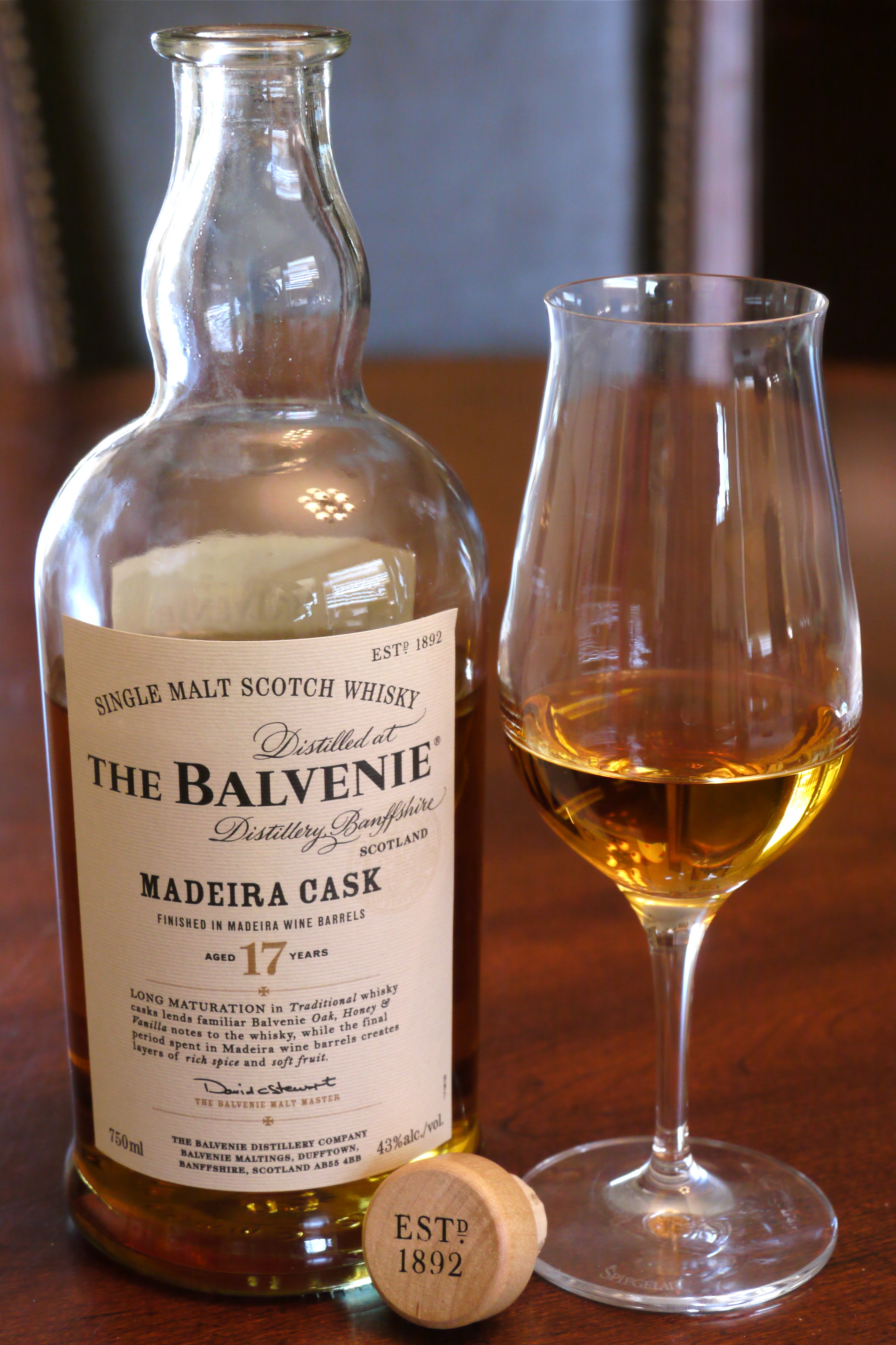
This past holiday season was a great time to be an amateur whisky blogger. Marketing companies are into social media big-time these days. In addition to starting up Facebook pages, blogs and company-owned Twitter accounts, they’re reaching out to “real people” with these same types of accounts to get their message out. Around the same time I was contacted about receiving samples of JW Blue and Chivas 18 for review, I was contacted by a PR company representing The Balvanie, wondering if I was interested in trying out this year’s 17 year special release, finished in Madeira [fortified Portuguese wine] casks. Yes!

On December 23rd, a couple of weeks after I was told the sample would be shipped, a good sized package arrived that required signing. It was my sample, and I soon discovered why it had taken a little while to get here: the Liquor Fairy [amusing disclaimer mechanism from The Pegu Blog] had turned my small review sample bottle into a full 75oml retail bottle of The Balvenie 17 Year Madeira. Merry Christmas to me, and thank-you Balvenie! [Officially, it’s “The Balvenie”, but I’ll probably fall back on just plain Balvenie much of the time]

Tasting Notes

Ok, after 2 weeks of a head/chest cold followed by a couple of healthy days, and then a week with a stomach virus…here, finally, are my tasting notes on this Christmas present. Not that you were dying to hear my take on it, but it’s been frustrating for me.

The Balvenie Madeira Cask Aged 17 Years; 43%; 2009; $120

Nose: This is easy to nose, with the alcohol staying out of the way. Sweet spices hit me straight away. Cinnamon & sugar for sure, and maybe I’m influenced by other tasting notes I’ve read, but I’ll go with nutmeg as well. It’s also reasonably fruity. Perhaps some apple, but it’s more like baked apple, not a fresh/crisp fruit. Also more than a little raisin. Finally, a rich vanilla comes through, and as I pull away, just a hint of fresh oak.
Note: On a couple of occasions, I felt there were some chocolate/orange on the nose, not unlike that part of the Dalmore 12 profile. However,  the above notes represent a more consistent picture of what I’m getting from this bottle.
Palate: More than most other whiskies I’ve tried, the nose prepared me perfectly for the mouth experience. Sweetness is quickly balanced by fruit and followed by the spices. There’s a bit of spicy tingle, but it’s pretty tame. I wouldn’t call this heavily bodied, but it’s not watery either.
Finish: No surprises on the finish. The taste just carries straight on through and slowly fades after a medium duration. Perhaps just a bit of added maltiness lingering at the end. With other Balvenies I’ve tried, there has been a little bitterness on the finish (not necessarily in a bad way), but there’s none of that here. There is some marginal drying on the finish.

Comments: I was struck by the consistent story this dram tells from first nosing to finish. That doesn’t mean it’s overly simple, though. While nothing particularly new was introduced on the palate and finish, nothing was really taken away from the multi-dimensional nose, either. This whisky is very smooth and accessible, and should appeal to a wide audience. Also, [not taste-related, but…] I love the Balvenie bottle shape. It makes a great glug-glug-glug sound when pouring. 🙂

Rating

  • Score: 87/100 (B) I’ll still reach for a peated malt most of the time (even lightly peated like HP), but for a Speyside that’s not heavily sherried, this ranks pretty high for me.
  • Bottom Line: Very impressive Madeira cask integration, providing an extremely balanced and accessible whisky. The Madeira finish provides some nice spices that you don’t get every day with a Speyside scotch, without blocking out the fruitiness of the spirit. Enjoyable from start to finish.
  • Score higher if: You’re a big Balvenie fan to begin with, and/or Speyside is your favorite scotch region.
  • Score lower if: It’s all about peat and/or big sherry for you. This one won’t change your mind about more subtle Speyside offerings.
  • Value: This is definitely a step above the younger, very nicely priced Balvenie expressions. I think the Edinburgh Whisky Blog hit the nail on the head when they put this in their Christmas Gift Guide, as it would make an excellent gift, and appeal to both the occasional drinker and the connoisseur. At $120, though, I don’t see a lot of people buying this by the case. To consider the premium Bavenie expressions “values”, I’d want to see the Bavenie 21 year Port Wood come back down below $150, and these 17 year releases at or below $100.

Comparisons

Younger Balvenies

I did some direct comparisons with the 15 year Single Barrel and 12 year Doublewood Balvenie expressions. You can definitely taste the family resemblance when comparing to the Doublewood, which brings fresh apples, vanilla, some spices and a bit more oak to the nose. The Madeira takes this base profile to the next level. Everything is richer and smoother. There’s less fresh oak, but the vanilla is much richer. The 17 year also brings those additional spices from the Madeira cask. As for the 15 year, it’s got HUGE fresh oak. I like oak with stronger whiskies (Laphroaig QC comes to mind), but it’s almost too much for me here. I definitely like the way the finish tones this down in the 17 year Madeira expression. I also find the 15 SB to be much more “spirity” than the Madeira Cask, with the alcohol being more prominent on the nose.

Glenmorangie Quinta Ruban

My first dram of Balvenie 17 year Madeira immediately called to mind the Glenmorangie Quinta Ruban, a 12 year finished in port casks. Madeira and port casks, both having previously housed fortified wines, seem to offer similar contributions to the whisky, at least where the spices are concerned. I’d love to see a review of this expression by Serge over at Whiskyfun. He doesn’t seem to be a big fan of the Glenmorangie finished expressions. However, to my [admittedly much less experienced] palate, this finished Balvenie feels very nicely integrated and balanced. Much less “constructed” than the Glenmo bottlings. That being said, I like the Quinta Ruban very much, and it does manage to scratch the same itch for me that the Balvenie Madeira does at a 60% discount in price.

Other opinions

There even more reviews than this out there, but here are some that stood out to me:

  • What Does John Know (Malt Advocate): – John was impressed by the balance of this whisky and awarded it a very impressive 90 points. I probably could have just copied and pasted his notes to represent my own findings.
  • Dr. Whisky: The good Dr. considers this one of the best in the Balvenie 17 year series.
  • whisky-pages: They also mentioned the shift from fresh fruit with their “stewed apples” reference.
  • Edinburgh Whisky Blog: Definitely some different references in the tasting notes, but I can see where they’re coming from.
  • Drinkhacker: An A- rating, but with a disclaimer that some might be put off by the Madeira finish. Perhaps, but I still think this is an amazingly accessible whisky.
  • discover whisky: Why wasn’t I aware of this blog already? I really like their notes in this review.

Hi. My name is Jeff, and I have a bias toward whisk(e)y distilled from peated barley. I also keep notes about the whiskies I drink and publish them, along with ratings, in a publicly accessible blog. Are these two statements at odds with each other? There are a growing number of whisky blogs with tasting notes. Some have ratings, some don’t. I never really thought of one approach as being right and the other being wrong. I just figured this was a case of communication preference on the part of the authors.

This blog post is really a follow-on to my recent post pointing out my new Google Docs ratings spreadsheet (link in the side bar). There are a couple of things that prompted me to continue the ratings discussion here. First, I’m still getting over a cold that has kept me from posting whisky tasting notes for the past 7 days. Second, I was just revisiting my trusty Malt Whisky Yearbook 2009 and read the following quote in the “Classifying Whisky” article by David Stirk:

Because scores are personal and very biased it is actually an arrogance to print them as it is the author stating: ‘This whisky is better than that whisky. Why? How dare you ask! Because I say so!’

Wow! Talk about forcing your personal bias on others (and putting words in their mouths). I decided to go to my favorite whisky ratings web site, WHISKYFUN.COM, and see what Serge has to say about his scoring system. I found a link in the sidebar to one of his E-pistles from Malt Maniacs #102 titled Serge’s Simple Tasting Tips. This is a great article on the topic of doing “serious” tastings. On the subject of scoring, he had this to say:

This is rather controversial matter… Some aficionados hate scores, some others will score even orange juice.
I do use scores myself, mostly because it’s the best way to remember to which extend I once liked a whisky without having to read my notes. But a score is not a judgment, it’s just a summing up of various feelings and likings.

Obviously, Serge isn’t trying to make a universal, objective statement with his ratings. His description very well summarizes my own feeling about doing ratings. It’s a way of summing up and tracking my whisky preferences over time. Why a particular score? There are corresponding notes explaining why, and I have yet to read or write any tasting notes that are likely to be paraphrased as “Because I say so!”

Let’s go ahead and assume that the majority of whisky hobbyists feel the same way as Serge when it comes to scores. They’re personal opinions at a point in time, and they’re likely to reflect any bias of the author. If we recognize that there is a bias, is it still appropriate to share our personal scores with others? I think so.

First, there is the obvious case where you find somebody whose preference seem very similar to yours for a particular kind of whisky. Once you’ve established such a connection, doesn’t it make sense to be interested in that person’s personal evaluation of whiskies you haven’t tried before?

As for bias, the key is getting to know a person’s preferences and taking them into account when you read their scores. I’m always on the lookout for “interesting”/different whiskies. One way such whiskies come to my attention is from an uncharacteristically high rating by a whisky enthusiast for a distillery not typically associated with their preferred tastes. Maybe I’m just too much of a whisky geek, but that kind of thing gets my heart rate up a little bit and makes me want to research that expression further.

Perhaps Mr. Stirk’s remark about arrogance in whisky rating is aimed more at the professional reviewer, such as Jim Murray. Admittedly, Mr. Murray comes across as a bit more “confident” than most others in his analysis. He states in his Whisky Bible that he’s honed his skills and ability to recognize certain traits in whiskies over 30 years, implying that he really DOES have a more objective viewpoint than most other whisky drinkers. Hey, I’m willing to give Mr. Murray the benefit of the doubt, and I appreciate the amount of time he’s invested into learning about and appreciating whisky. That doesn’t mean I have to treat his ratings differently than I do any others. It’s another source [with its own set of merits to consider] that I’ll compare against my own tasting impressions in order to help me pick my next bottle. I’m glad to have one person’s take on several thousand expressions available in an easy to browse reference.

Finally, I have this to say about ratings. If you’re looking for help picking a whisky, don’t forget to look beyond the number of stars, or points out of 100. Try to get familiar with the author so that you can apply a filter to their scores based on bias, experience, and relative consistency with your own findings. If you’re dead set against scores, then ignore them and focus on the corresponding tasting notes. No need to get your panties in a bunch. Just take what you will from a whisky review and enjoy your next dram.

Cheers,
Jeff

Introduction

I’m taking advantage of my down time with a head/chest cold to do some non-drinking whisky enthusiast activities. In this post, I want to point out my new Ratings Spreadsheet link in the side bar, which points to a Google Docs spreadsheet containing my ratings history. The spreadsheet lists the classification, numeric score and grade for each expression I’ve rated, along with a link to the blog post where I provided my tasting notes.

Why do ratings?

The whole point of the ratings is to help articulate my enjoyment of a particular whisky, both on a “good/bad” scale, and relative to others that I’ve tried. I don’t fancy myself a whisky “expert”, and I don’t believe there is such thing as a “universal” rating for whisky expressions that will apply to everybody. You need to understand the tastes and history of the person providing the scores for them to be useful. I talked more about this in a previous post on rating whiskies (and in the comments for that post).

About the spreadsheet

I created this spreadsheet as a convenient index for looking up previous reviews and scanning my ratings. The whiskies are ordered by Distillery and Age. If you’re so inclined, you can create your own Google Docs copy (if you have an account), or download to Excel (File | Download as…) to change the sort order. A little more info on some of the columns:

  • Classification: This is a distillery classification from Whisky Classified: Choosing Single Malts by Flavour, David Wishart, Pavilion Books, London 2002. On the web, here. The idea is to group distilleries based on similar traits in their whiskies. In some cases, I filled in a different Classification than is associated with the distillery. I’ve marked these with an “*”. An example would be a peated expression from a typically non-peated distillery.
  • Rating: This is the numeric rating that I gave to the expression in a blog post on a 0 to 100 scale. I discussed the scale in this previous ratings blog post.
  • Grade: This is a less specific rating than the numeric one. If I only try a small sample of a whisky and don’t feel comfortable giving a specific numeric score, I’ll use this broader rating only.
  • Blog Link: Note that if you click on this cell in Google Docs, you’ll get a link indicator on the left side of the cell that will take you to that blog entry.

Conclusion/Disclaimer

Between the time I posted the spreadsheet and got to this point in the blog post (less than a day), I got caught in the cross-hairs of this Dr. Whisky blog entry (I do like his blog…you should check it out if you haven’t already). Therefore, I feel compelled to sneak some time on my lunch break, finish this post, and once again point out that I’m not publishing this spreadsheet as a “whisky expert.” I’m one of an increasing number of whisky enthusiasts taking advantage of blogging software to share a passion for whisky, and the processes and history behind its making.

[Update: Ok, maybe the good Dr. wasn’t picking on my ratings, so much as just making the same point I just did…that there are a lot of folks on the web with opinions about whisky. It’s kind of cool that he’s aware of a bunch of us amateur enthusiasts, actually.]

Providing a grade for the whiskies I drink is a personal choice, and just a small component of what I’m trying to share on this blog. If you’ve decided to follow my posts, and you’ve discovered a consistent similarity or disparity between my preferences and yours, perhaps these ratings will help point out other whisky expressions that would appeal to you. I’d certainly encourage you to do additional research (check out my Whisky Resources page), or take a leap and try new expressions as part of your own discovery.

Oh, and if you accidentally stumbled upon my ratings list in search of a mythical “matrix” of whisky ratings by the closest thing there is to whisky experts, the least I can do is help you on your quest. Follow this link and hit the yellow or red “MM” buttons.

Cheers,
Jeff

Introduction

Lagavulin 16 (2009)

I think this is my first repeat review, but I’m going to change my rating on this one, so I wanted to write about it again. I’m talking about Lagavulin 16 (43% abv), this one bottled in 2009. This expression is surely matured in a mix of bourbon and sherry casks, but I can’t find any concrete description of their “recipe” like HP provides for their various expressions. My previous Laga 16 review was based on a 200ml bottle from 2006 that came with my Islay Collection pack. The price of this well known Islay single malt has dropped at the local big box liquor store (in AZ) from $80 to $70, more in line with California pricing. I hope it stays that way!

Tasting notes

Lagavulin 16 (OB); 43%; Bottled 2009

Nose: Great balance of peat smoke and sherry fruits/sweetness. The sherry isn’t strong, hinting at mixed cask maturation, but the overall effect is a rich one. It’s smoky, but not quite the camp fire you get with Ardbeg. There’s oak, but not in your face like Laphroaig QC. Definitely some iodine involved in the mix as well.
Palate: A rich, creamy mouth feel with a pleasant drying sensation and a bit of subtle spice. All parts of the tongue are involved in the experience. It could be stronger, though, with more spiciness. I think it would border on perfection if they could infuse a Talisker-like pepper and bottle it at 46-48%.
Finish: Very long, with continued drying on the tongue, along with some sweetness. Peat smoke and dried fruits linger perfectly in the back of the nostrils.

Comments: I’ve probably tried 50 additional whisky expressions since I first had Lagavulin 16. I still haven’t found a better “standard” expression, and only a couple of the premium bottlings I’ve had can equal or beat Lagavulin 16 (for my tastes). I know there are still a LOT of whiskies out there to try, but no matter what I discover in the future, this one will stand as an amazingly balanced and rewarding dram. Sure, I’d like to see it bottled at a little higher ABV, but I’m not sure they can afford to do this. It might be too good of a core expression! What would they do for an encore?

I put this right below Laphroaig 30 and HP 30, with this one being a much better value.

Rating

  • Score: 92/100 (A)
  • Bottom Line: Amazing balance and grace for a smoky, medicinal Islay malt. One of the very best.
  • Score higher if: Well, 92 points is pretty high. You’re just going to have to try it and see if it’s “special” to you.
  • Score lower if: 43% just doesn’t cut it for you anymore; you prefer a more ashy/tarry peat in your Islay malt.
  • Value: Not cheap at $65-$90, but I have no problem with the price, as I think this tops all of the 18 year malts I’ve tried in the same price range.

Comparisons

I compared this new 2009 bottle to the end of my 2006 Laga 16 bottle. They’re very similar, but I felt like there was a little bit of additional toffee sweetness in the 2006 version. Both on the nose and the finish. I think it was because of this that the smoke and dried fruits seemed a little more muted on the nose in the 2006 bottling. I also tried a little bit of Laphroaig Triple Wood next to the two Laga 16 drams. I really like the Laphroaig, but the sherry cask finishing just doesn’t provide quite the same level of integration and balance that the Lagavulin 16 offers.

I would compare the Laga 16 and 12 year old expressions, but they’re really completely different beasts. The 12 year (most likely matured only in bourbon casks) reminds me of a cask strength Caol Ila. Much more ashy and peppery than the 16 year. Plus, the 12 year is bottled at cask strength. The 12 year is also excellent, but you need to try both. It’s not an either-or proposition.

Other opinions

WHISKYFUN.COM by Serge has reviewed a 2009 bottle of Lagavulin 16 and gave it a very respectable 90 points. Check out Serge’s great review.

The always entertaining Ralfy recently did a video review of the Laga 16. He also gave it 90 points:

Introduction

Chivas Regal 18 (200ml)

I’m sitting at my laptop, trying not to allow my rose-colored glasses to impact the content of this post. You may have noticed the plethora of Chivas 18 blog posts hitting the net over the past couple of weeks. Well, now it’s my turn to pile on.

A PR firm working with Pernod Ricard has been sending out samples of Chivas Regal 18 and Johnnie Walker Blue to bloggers as part of a campaign to raise awareness for Chivas as a premium, gift-worthy blend. I don’t know how I got onto their radar, but don’t you dare clue them in that I’m a second-rate hack. Getting free samples is freaking awesome!

Tasting Notes

Chivas Regal 18 “Gold Signature”; 40% ABV; $50 – $60

This is a Speyside-based blend, with the Strathisla distillery (bought by Chivas Bros. in 1950) reportedly playing a key role. According to World Whiskey (by Charles Maclean), Strathisla 18 is not available commercially, so Chivas 18 is the dram to have if you want some of this rarity.

Nose: Have you ever had Apple & Cinnamon Quaker Instant Oatmeal for breakfast? That’s the combination of scents that hits me with Chivas 18. There is also some honey, bordering on toffee, sweetness. Towards the end of a long whiff, I get additional fresh fruits like apricots and cherries.
Palate: The medium body is sweet and lightly fruity. The subtle spices are so light that you’ll likely miss them completely if comparing directly with other whiskies.
Finish: Subtle fruit and maltiness, along with a little vanilla. There is a delayed drying on the tongue, and no real alcohol burn to speak of.

Comments: Having previously referred to the Chivas 12 as “enjoyable but forgettable”, I was pleasantly surprised by the Chivas 18 year. The nose actually has quite a bit going on. The palate is a bit richer than the 12 year, and the finish lasts longer, but it’s still a blend that favors politeness over impact. I definitely enjoy this more than entry-level Speyside malts such as Glenfiddich 12 and Glenlivet 12, and feel it’s worth a jump in price based on taste alone. I’ll continue to evaluate this, but I’d give it a preliminary rating of B (83-87 points). Right in line with a single malt like Bunnahabhain 12. [Hmm…maybe a head-2-head between these two is in order]

Comparisons

Johnnie Walker Blue; 40% ABV;  $175 – $225

I would call JW Blue more of an “Island” blend vs. the Speyside focus of the Chivas 18. I’ve decided that there is little to gain by doing a full side-by-side analysis of tasting notes because of the different profiles. However, there are certain traits that are worth comparing. Both of these blends offer interesting noses, then yield to a more polite, accessible palate and finish. The JW Blue is especially impressive in its ability to melt away in the mouth and leave faint wisps of smoke in a way that won’t scare off the casual whisky drinker.

The Balvenie Founder’s Reserve 10 Year; 43% ABV;  $40 – $50

The Balvenie FR 10 is vatted from a mix of bourbon and sherry casks, and offers a profile that is VERY similar to the Chivas 18. The nose is very close to the Apples & Cinnamon oatmeal that I described above. I don’t get the additional cherries/apricots with the FR 10, though. Perhaps not quite as much sherry influence? On the palate and finish, I think there is a little more impact and last with the Balvenie, with more spices on the tongue. I was surprised at how close these are, though.

Longmorn 16 (2009); 48% ABV;  $80 – $100

Longmorn 16

Here’s a Chivas-owned single malt from Speyside that comes in very nice packaging and seems to disappear off of the shelves more quickly during the holiday season. It’s also a key component [the primary one?] in Chivas 18. Aged strictly in bourbon casks, the profile is different than the Chivas 18 and Balvenie FR 10. However, there are some common apple and cereal notes. What I wanted to draw out is the fact that there is much more impact on the palate, and a more aggressive drying on the finish, along with some bitter/sweet interplay. Having been focused primarily on single malts during the past year, I really appreciate these stronger traits in the mouth. However, I don’t think it’s quite as safe as Chivas 18 when it comes to gifting.

Conclusion/Value

Q: Is Chivas Regal 18 worth $55, and would it make a good gift?

A: Yes. I think it fits nicely between some of the entry level Speyside single malts and something like the Longmorn 16. It offers an interesting nose while remaining very accessible to the occasional whisky drinker, and it comes in nice packaging (locally, anyway, it comes in a fancy gift box similar in quality to the Longmorn 16 box). I don’t think it provides much of an improvement over Balvenie 10 FR, which costs less. However, there’s often more to perceived whisky value than taste. You’re paying for the age statement, knowing that you can’t get 18 year Strathisla anyplace else, and 18 year Longmorn is also a treat.

Q: Is Chivas Regal 18 a valid gift substitute for Johnnie Walker Blue?

A: No. If you were planning to impress somebody with a generous gift of Johnnie Walker Blue, do NOT expect to substitute Chivas 18 and get the same results. I’m not saying this is right, or that there is a quantifiable difference in the whisky itself that makes JW Blue worth 3-4 times the price. However, there is a certain mystique associated with JW Blue that a $55 blend cannot match. I’ll touch on that in a separate post.

Mystique aside, I’ll probably be scoring JW Blue a few points higher than Chivas 18 when I cover it in a separate review. There are also plenty of reasonably priced single malts that I have scored higher than either of these very pleasant blends. That doesn’t really have anything to do with the perceived value of the Chivas, though. If somebody gave me a bottle of Chivas Regal 18 for Christmas, I’d be very appreciative, and it would likely be a part of some good times with good friends in the coming months.

Other Opinions

Here are a bunch of links to other blog posts resulting from this Chivas vs. Johnnie Walker campaign. Happy reading!

Introduction

I got an email from Tom in Toronto, asking if I have a Windows version of the Easy ABVs Calculator that I wrote for the iPhone. He wants to compare varying strength whiskies at the same ABV. I don’t have a Windows version of the program, but it sounded like a good idea. Instead of writing an actual stand-alone Windows program, I decided to create a quickie Excel spreadsheet.

With this spreadsheet, you can enter up to 10 whisky expressions with their out-of-the-bottle ABV and have the spreadsheet calculate how much water to add in order to reach a desired final ABV. You can also use it to just manually enter the whisky and water volumes and have it tell you what the final ABV will be. Finally, the spreadsheet will keep track of drink units so you know your total alcohol intake for the tasting session.

Preview and download

I’ve uploaded the Excel spreadsheet to Google Docs.  Click this link to view it.

You’ll see that I’ve entered a number of Laphroaig expressions and requested that they all be converted to 40%, using 25ml of whisky as the starting point. For Batch 001 I entered an exeption, starting with 20ml of whisky. The spreadsheet is telling me to add 9 ml of water to the Batch 001, 5ml to the QC and 18, and no water needed for the Laph 10, which is already at 40%.

Downloading: From the Google Docs preview above, you should be able to click “File | Download as…” in the menu and save the spreadsheet in Excel or a number of other formats. If you don’t have Excel, you can save it as an OpenOffice spreadsheet and use something like NeoOffice (free) to use it.

Spreadsheet instructions

  1. Fill in the “Desired final ABV” that you would like all entered drinks to end up at.
  2. If you’d like to have the same total volume in each glass, then enter the “Desired total volume”. The spreadsheet will then tell you how much whisky and how much water to use for each expression.
  3. If you’d like to pour the same amount of spirit into each glass, then add water to reach the desired ABV, then enter “Desired spirit volume”, but make sure you clear out “Desired total volume” first.
  4. The Drink Unit size is used to determine how many drink units are in each pour. The standard UK and US drink sizes, as well as recommended maximum intake, are listed at the bottom of the spreadsheet. The default drink unit size is based on the U.S. recommendations.
  5. Now enter each whisky expression in the Drink Details area. The description is optional, but you need to at least enter the ABV as indicated on the bottle. If the alcohol content is listed in Proof, divide by 2.
  6. You can ignore/override the “desired” ABV and volume values by entering the Spirit and Water Volume in the Manual Calculation section. If you enter Spirit Volume here, this will override the “Desired total volume” or “Desired spirit volume” at the top of the spreadsheet.
  7. Read the Spirit and Water volume (in ml) in the Calculated Values area, as well as the number of drink units per expression. Total pure alcohol and drink units, as well as overall average ABV are in the “Totals” at the bottom.

Conclusion

So…what do you think? Is this something you can use? Any suggestions for modifications? You can use the links in the Scribd previews above to download the spreadsheets and use/modify them as you see fit. Like I said above, I personally prefer the second one. I just created the taller/narrower one so that it would divide things up more logically in the Scribd preview.