Feeds:
Posts
Comments

Introduction

Here we go with my first review of a free Master of Malt sample. It’s a 20 year old Glenfarclas from the Family Cask series, bottled at 56.5%. There were 521 bottles produced from a single refill sherry puncheon. I’m going to compare it with the standard Glenfarclas 17 year old release.
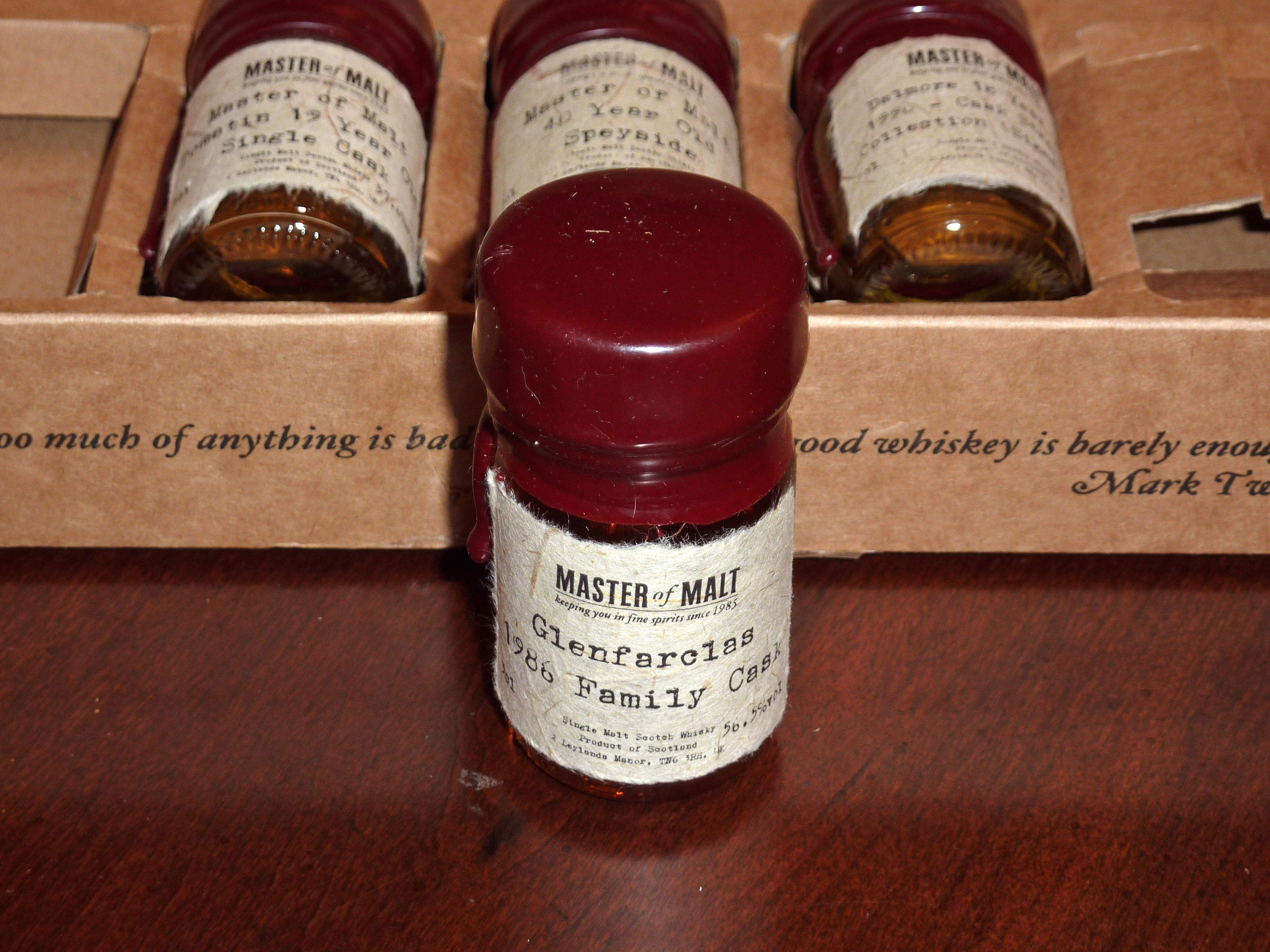
MoM 3cl Samples and packaging

I already discussed what’s going on with these samples from MoM. I’d like to additionally editorialize that their sample program is pretty sweet. As long as you’re comfortable with the prices they charge for the samples you’re interested in, everything else is top notch. Excellent packaging with really nice looking wax-dipped bottles, and very fast shipping. The only down side is I’d rather see 40 or 50 ml samples, depending on how much extra they would charge.

Tasting notes and comparisons

Glenfarclas Family Cask 1986 (cask #3434; 56.5%; 70cl $260, 3cl $15)

Glenfarclas 1986 Family Cask

Nose: There is light sherry influence of the dried fruits variety, but it is somewhat muted. Rising above the sherry are distinct oak and vanilla notes. There is also an underlying sweetness. Adding some water brings the sherry notes out more, and makes it more balanced.
Palate: This one has a very rich feel on the palate, initially juicy on the tongue, followed by some nice spices and drying.
Finish: On the finish, it’s still kind of spicy, with the oak returning, and finally turning a little malty. It’s not a particularly long finish, but it’s nice while it lasts.

My rating: 87 points

Glenfarclas 17 Year (43%; 75cl $85)

Nose: The same kind of sherry (dried fruits) as the 1986, as well as vanilla and oak, but the fruit stands out more, and the oak stands down to create a more balanced presentation.
Palate: Malty and sweet, and lightly spiced, with noticeable drying on the tongue.
Finish: Balanced on the finish, just as on the nose. Less oaky again than the Family Cask, which I think is a good thing in this case. It’s probably just the oak/malt combination, but in the nostrils, I could swear there’s a hint of Highland Park style smoke that lingers for a while.

My rating: 88 points

Comparison

Neither one of these is a “sherry bomb.” Look to first-fill sherry cask expressions for that. The 1986 brings increased oak on the nose and finish relative to the 17 year, to the point that it might be a little much for some people. Add a little water to balance it out. And of course, there’s the higher ABV, which provides more impact. The 17 year offers increased maltiness on the nose and finish, and perhaps a hint of smoke. For me, the 17 year wins out on the nose, the 1986 has an edge on the palate, and the finish goes once again to the 17 year.

Bottom line

If you’re a fan of medium-sherried whiskies that allow the oak flavors to come through, you’ll probably like the 1986 Family Cask. However, price is certainly a consideration. I would not pay $260 for a bottle unless I really wanted something tied to the year 1986. That being said, this Family Cask bottling is a very enjoyable whisky, and thanks to Master of Malt, if you’re considering buying one to celebrate the year 1986 in some way, you can try a sample for $15 [hey, that was a pretty good plug, huh?].

The Glenfarclas 17 year isn’t as big on the palate, but otherwise offers a very similar, and in some ways more balanced profile for much less money. I’m very impressed with this expression, and purchased a backup bottle when it was on sale locally.

This is a pair of extremely enjoyable medium-sherry whiskies and both are highly recommended based on taste. For value, the 17 year obviously wins out.

Master of Malt info

Many thanks to Natalie and the gang at Master of Malt for picking out a set of samples and supplying them to me. This special, rare bottling sample was a nice surprise. Check out MoM on the web here:

Once again, here’s the link to the Glenfarclas Family Cask 1986 page, where you can purchase a full bottle or sample. For the record, this is not an affiliate link. I’m not currently participating in any such programs.

Cheers,
Jeff

Introduction

Hey, this is pretty cool. Anthony Wills from Kilchoman [kill-HOE-man] will be visiting the U.S. in November, and doing bottle signings. The Kilchoman Summer 2010 release will be the first Kilchoman bottling officially imported to the U.S. (by ImpEx beverages). ImpEx just sent out information about Mr. Wills’ visit and I’ve included his schedule below. You can see my thoughts (and links to other reviews) on previous Kilchoman releases here.

Special bottlings

The Whisky Shop in San Francisco, and Binny’s in Chicago have each selected a single cask from the Summer 2010 release, and will have these available bottled at cask strength! If you live in San Francisco or Chicago…get your butts over to these stores and get your signed single-barrel bottling. The Whisky Shop signing event will be on November 6th. Binny’s, November 8th.

Anthony Wills U.S. visit schedule

Nov 6: The Whisky Shop 360 Sutter Street, San Francisco, CA  415-989-1030
Bottle Signing
Nov 7: Hyatt Vineyard Creek Hotel, 170 Railroad Street, Santa Rosa, CA
Sponsored by:  Traverso’s  707-542-2530
5:00 to 7:00 Bottle Signing and Tasting
Nov 8: Binny’s  1720 N. Marcey Street, Chicago, IL 60614  312-664-4394
6:30 to 8:00 Bottle Signing
Nov 10: Gary’s Beer & Liquor 9555 S. Howell Ave, Oak Creek, WI  414-762-3010
10:45 to 11:00 Bottle Signing
Nov 10: County Clare Irish Inn & Pub  1234 N. Astor, Milwaukee, WI  414-272-5220
12:30 to 2:00 Bottle Signing and Tasting
Nov 10: Waterford Wine C0mpany  1327 E. Brady Street, Milwaukee, WI  414-289-9463
3:00 to 5:00 Bottle Signing and Tasting
Nov 10: Union House S42 W31320 Hwy 83, Genesse Depot, WI  262-968-4281
6:30 to 8:00 Bottle Signing and Tasting

Introduction

I’m going to be doing a few scotch reviews soon based on samples from Master of Malt. Four of them are free samples that I got as part of a promotion they seem to be doing with bloggers. Before I start posting these, I thought I’d write up a quick disclaimer to link to from my reviews. I know this is an area (free samples) that can be controversial with some people.

About Master of Malt

Master of Malt (MoM) is a pretty cool online whisky retailer. You can get some insight into the company by reading this blog post/interview from The Jewish Single Malt Whisky Society or this one from Whisky Emporium. They also offer a series of whiskies under their own label. What’s especially unique about them is their offering of 3cl samples (packaged themselves from full sized bottles) of many of the whiskies they sell.

I’ve been a big fan of the ability to buy whisk(e)y samples for some time. I was able to blog about the full range of Highland Park (up through 30 year) by purchasing samples from Loch Fyne Whiskies and The Whisky Exchange. These were samples bottled by the distillery. I was also able to try most of Diageo’s special releases last year via WhiskySamples.eu, who specialize in samples of rare expressions. Now we have Master of Malt with their “Drinks by the Dram” try before you buy service, with prices ranging from about $3 to over $100 for a Glenfarclas 1952 family cask.

Here’s the deal

Ok, so Master of Malt is focusing on their internet business, and trying to get the word out about their online store and services such as Drinks by the Dram. One way of doing that is via whisky enthusiasts such as myself who have blogs. I’ve received a few free samples from other sources in the past (and always disclosed that fact), but those were from the distilleries, or their marketing representatives. There was never any kind of stipulation tied to the samples. In this case, the four free samples I received from MoM did arrive with a few strings attached, which is what I wanted to clarify in this blog post.

MoM has requested the following from any reviews tied to the samples they sent me for free:

  • A link to the Master of Malt home page
  • A link to the product page for each dram
  • Links to their social media pages (Twitter, Facebook)
  • Mention in the post of who supplied the sample

That’s it. They also stated clearly that they have no expectations for any particular types of reviews – no minimum word length; no time limit; no specific link blocks or anchor terms. They stressed that the reviews should be totally independent and unbiased. Overall, it sounds pretty reasonable to me. I don’t feel any pressure to behave differently when posting about these whiskies than I do with bottles I bought myself, or samples I traded for with other enthusiasts.

As far as I know, this was a one time offer. I’ll plan on buying samples myself in the future (as long as the price point works for me).

Conclusion

If you have any issues with the idea of some of my blog posts being based on free whisk(e)y samples, that’s fine. I get it. I’m not going to turn them down, though. I enjoy having the opportunity to try new whiskies. Most of them will come from my own purchases, or trades with other enthusiasts. Now and then, a unique opportunity like this one will come up, and I have no intention of passing on these opportunities, as long as I’m not asked to do anything “sneaky.” If it makes you feel any better, I have no means of receiving any kind of income from this blog. It’s 100% amateur hour here…no affiliate links, etc. (not that there’s anything wrong with that).

So, with that out of the way, I’m going to proceed with a clear conscience, enjoying as many types of whisk(e)y as I can, and sharing my thoughts, for as long as I continue to have fun doing it.

Cheers,
Jeff

Doh! I got this press release that Richard Paterson is going to be hanging out and signing books near Newport beach this coming Tuesday, a mere 6 hour drive from Phoenix, AZ. Unfortunately, I’ve got prior commitments and won’t be able to go. If you’re in Southern California, you should stop by and meet the famous Master Blender:

MASTER BLENDER RICHARD PATERSON IN
COSTA MESA ON OCTOBER 12

COSTA MESA, CA – Award-winning master blender, Richard Paterson, will visit Hi-Time Wine Cellars at 250 Ogle Street in Costa Mesa from 5:00 – 7:00 p.m. on Tuesday, October 12th for a Grand Single Malt Scotch Bottle and Book Signing.

Richard is one of the most respected blenders in the Scotch world who recently celebrated his 40th anniversary with Whyte and Mackay. He constantly challenges palates the world over with his unique blending style, award-winning whiskys, and of course, stories of his travel. Richard’s passion for Scotch stretches back three generations to his grandfather William Paterson, who changed his career from being a coal merchant to a Glasgow whisky broker. His father continued as a broker and Richard followed – and chose the path that he was most curious about – creating whisky.
Richard is the author of Goodness Nose and can be found online at:

http://www.twitter.com/the_nose

http://www.youtube.com/user/masterblenderrichard


EVENT: Grand Single Malt Scotch Bottle and Book

Signing with Master Blender, Richard Paterson
DATE: Tuesday, October 12, 2010

TIME: 5:00 – 7:00 pm

LOCATION: Hi-Time Wine Cellars

250 Ogle Street

Costa Mesa, CA 92627

Introduction

I got an email a couple of weeks ago from Stephanie Jerzy of NOVA Marketing asking if I’d like to participate in a Chivas Regal tasting event taking place in NYC on October 5th. Leading the tasting would be Chivas Brothers Ambassador Alex Robertson. The 2,500 miles between myself and the event were not to be a problem, as they would send me a set of samples and hook me up to the event live via chat room. The price was right, too ($0.00). Sold!

The samples they sent included four 50ml bottles of non-commercial whiskies: “Islay 18”, “Grain 18”, Longmorn 18, and Strathisla 18. These are described as being some of the “key components” that make up the Chivas Regal 18 blend, which I previously reviewed here. They also included 200ml bottles of Chivas Regal 18 and Johnnie Walker Blue. I don’t find the Chivas/JW comparison particularly meaningful, as they’re very different taste profiles, but I’m not going to turn down a free 200ml bottle of JW BLue. I do love having the ability to break down a blend into its components. This is what Johnnie Walker did last year with their Art of Blending webcast. I think this is by far the most intriguing and satisfying way to hold a blended whisk(e)y tasting.


The components of Chivas Regal 18


The Event

There were about 20 bloggers participating in the event remotely. We were able to chat with each other, and Stephanie tuned us into the live action via webcam right there in the chat room. It was nice to be able to compare notes with the other bloggers and ask each other questions. As we went through the tasting, Stephanie served as our proxy, reading some of our questions out loud at the event, and making sure we heard the answer. Prior to starting the actual tasting, the participants in NYC were given a cocktail named “The Crooner Fizz”. I haven’t tried making it yet, but here is the recipe:

“Crooner Fizz” ingredients

  • 2 oz Chivas Regal 12
  • .5 oz Chairman’s Reserve Rum
  • .5 oz lemon juice
  • .5 oz raisin syrup
    • [Raisin syrup recipe: 1 cup muddled raisins boiled in 2 cups water]
  • Topped with Perrier Jouet Champagne

The Whiskies

A couple of interesting facts came out from the Q&A.

  • The Islay and Grain 18 samples are blends from different distilleries.
  • Chivas Brothers sources the spirit, but then takes control of the maturation process themselves.

We worked through the samples in the following order:

  • Strathisla 18 – I was really excited about being able to try this, as the only standard Strathisla distillery bottling is a 12 year (which I haven’t tried either). It seemed like more of a treat than the Longmorn 18 vs. the standard 16 year. 🙂 The Strathisla is very nice, with an apparent sherry cask influence providing pleasing red grape and dried fruit notes. There’s also a clean maltiness that carries through to the finish. In fact, everything about it is very clean. It’s not very spicy, but has a nice full body. Maybe a hint of smoke at the end? If they bottled this, preferably at 43% to 48%, and sold it for a reasonable price (closer to The Glenlivet 18 than Glenmorangie 18), I’d keep a bottle on the shelf. Many of the participants seemed to feel the same way.
  • “Grain 18” – Pretty much all I got out of this one was toffee sweetness and fresh oak. It’s ridiculously easy to drink, but doesn’t offer any real satisfaction unless your goal is just to get drunk. However, what really impressed me was the lack of aftertaste. This is a very clean base for the blend, allowing the single malts to shine through.
  • “Islay 18” – On the nose, I was hit immediately with a combination of sherry and iodine. Then I noticed a toffee sweetness and some smoke. It’s actually kind of easy going and fruity on the early palate, then headed into the finish I get big sweet smoke in the nostrils and another medicinal kick. The finish lasts a while and is quite drying on the tongue. I’d put money on there being a fair amount of Lagavulin in this based on the particular smoke/iodine combination presented. At first, I thought this would make a great “beginner” Islay whisky, but now I’m thinking the medicinal properties are a little over the top. Still, I enjoyed it very much.
  • Longmorn 18 – Hmm…not excited about this one. I much prefer my 2009 bottle of Longmorn 16. The 18 year provides similar fruity notes (more on the apple side than dried/red fruits) to the 16 year, but the 18 year has kind of a stale maltiness that i don’t care for. It seems a little “dirty” compared to the lovely Strathisla 18.
  • Chivas Regal 18 – I commented on Twitter that I thought another name for this could be “Strathisla 18 and friends.” The nose especially really brings out the same kind of fruits and clean malt that the Strathisla provides. The oak/vanilla/spices and sweetness from the Grain 18 is there, and a little extra apple kick from the Longmorn. Islay 18? I tried to find it in here somewhere, but at best, I’m getting a hint of peat smoke on the finish. I don’t think there’s much Islay 18 at all in the mix. The finish is medium in length and overall good, with maybe a hint of that “stale” malt from the Longmorn 18. In the end, it’s a very nice whisky that manages to keep most of the best traits of the Strathisla and Longmorn, adding some additional spices. It’s not going to blow your mind, but I found it quite enjoyable. The $55-$60 price tag seems very reasonable. Well done!
  • Johnnie Walker Blue – I won’t really get into the JW Blue here. I posted my thoughts on it recently. It’s a very good blend and fits right into some of my malt profile preferences. Especially with the increased Island/Islay influence relative to the Chivas 18. Granted, it costs upwards of $200.

Conclusion

We closed out with a return to Chivas Regal 18 and a toast. As for the “challenge” part of The Chivas Challenge Live…a few people voiced opinions favoring Chivas or Johnnie Walker, but I think the overriding opinion was that they’re both good in different ways. The Chivas folks didn’t really need anybody to come out and say Chivas 18 was better. Just presenting them as “equals” and getting people to debate the merits of each is a victory for Chivas Brothers, given the 3x price premium for JW Blue.

For me, this event was all about gaining insight into the components involved in creating the Chivas Regal 18 blend. It was interesting to see how smooth the individual components were. This probably has something to do with the manner in which they matured the whiskies. I had figured the smoothness of the blend was purely based on the recipe, but clearly their control over the maturation of the malts and grains plays into the final outcome. I was most impressed with the Strathisla 18 single malt and the Islay 18 blended malt. You can’t buy either, but if you try Chivas Regal 18, you’ll get a pretty good insight into the profile of the Strathisla 18.

Many thanks to Stephanie, Alex Robertson and the rest of the Chivas/NOVA teams for putting together this enlightening and entertaining event.

Cheers,
Jeff

Introduction

Today, I’m comparing three Penderyn [the only whisky distillery in Wales] expressions to see which I like best. Back at the beginning of the year, I posted a review of the standard Penderyn Madeira Finish expression. I thought it was a good, and very different tasting whisky. As far as enjoyment level, I thought it fit right in with the likes of Glenfidich 12 and Glenlivet 12. Pretty good for a 5 to 6 year old whisky. Although, the folks at Penderyn would likely point out that their unique distillation process ages the spirit faster than more traditional means. To learn more about the distillery, I recommend reading this great post from the folks at Whisky for Everyone.

I was fortunate enough to get 50ml samples of Penderyn’s Sherrywood and Peated expressions from the distillery. These two additional expressions are due to hit the shelves in the United States in October 2010, and I was curious to see which of the three would be my favorite. All three expressions should have a suggested retail price around $70. The Sherrywood is made from a combination of Buffalo Trace Bourbon and Oloroso Sherry casks. The Peated expression is not made from peated barley. Rather, they mature it in a combination of Bourbon casks and casks previously used to mature peated Scotch whisky from Islay.

Three Penderyn whiskies

Tasting

Let’s revisit the Penderyn Madiera Finish, then compare the others. Keep in mind that this is a small distillery, with bottlings created in batches (dates marked on the bottle). There could potentially be a fair amount of variance between the batches I’ve tried and other batches produced.

Note: All three expressions are bottled at 46%, which probably helped earn them an extra point. The dates listed correspond with the particular batches that I tried.

Penderyn Madiera (Nov 09) – I still find the nose to be fruity and topical, and a little bit sharp when initially poured. I’m also getting a pretty strong pine needle smell that I’m surprised I didn’t place the first time around. After some time in the glass, the pine dies down a little, and more vanilla appears. I definitely prefer this whisky after it sits in the glass for 20 minutes or so. The palate is lively and youthful, but not harsh. Still fruity, a marmalade bitterness is introduced heading into the finish that builds and lingers. Different. Perfectly enjoyable. 81 points.

Penderyn Peated (Sep 09) – This one has a very clear family resemblance to the Madeira finish. The unique distillery presentation of tropical fruits is there, but with an added twist…there is a citrus component that leans towards grapefruit. There is fresh oak and a little smoke, but I’m not really getting pine with this one. It’s vibrant on the palate, but like the Madeira finish, feels a bit on the young side. The grapefruit persists into the finish, accompanied by smoke. Grapefruit wrapped in tin foil and cooked on an open flame? Another very different whisk(e)y experience. I like it about the same as the Madeira finish, I suppose. 81 points.

Penderyn Sherrywood (June 08) – On the nose, this is much more Scottish (not sure how the Penderyn folks would feel about that). It’s very relaxed relative to the Madeira and Peated expressions. Definite sherry influence, with dried fruits, but also increased oak and vanilla. Quite a bit of vanilla, in fact. On the palate, it continues to be smooth and laid back. On the back of the palate, and into the finish, some of the youthful spirit and tropical fruits appear. The finish itself is quite smooth and lacks some of the marmalade bitterness of the other expressions. Even with similarities in places, it would be easy to mistake the Sherrywood for a different distillery from the other two expressions. The profile of the Sherrywood bottling is more my style. It reminds me of Aberlour 12 year, though not quite as rich as that one. It’s my favorite Penderyn so far, and one I would comfortably offer to whisky newbies as a very “accessible” single malt. 83 points.

Comments – Penderyn is a young company, having just started producing whisky 10 years ago. So far, I find their expressions to be in the good, but not great range relative to other whiskies I’ve tried. However, their distillery profile is quite unique. Because of this, I’ll probably make a point of keeping a bottle of Penderyn in my whisky cabinet. I’m also hopeful that as the company and its whisky continues to mature, truly great bottlings will follow. Perhaps sooner rather than later. If you get a chance to try any of the Penderyn expressions, take advantage of the opportunity. It should be a unique experience, and it might really float your boat. In fact, Jim Murray of Whisky Bible fame already finds many of the Penderyn bottlings to be top notch.

Other Opinions of Penderyn Sherrywood and Peated

It looks like the Penderyn folks distributed a bunch of samples from the same Sherrywood batch. All of the Sherrywood review links below are for the June ’08 bottling, as is Jim Murray’s Whisky Bible review, where he gave it 91 points. JM also reviewed several Peated batches, with scores ranging from 78 to 92.5.

  • Whiskyfun – This whiskyfun article compares the Madeira with the Sherrywood and scores them 70 and 80 points respectively. However, the Madeira sample he reviewed was from 2004, likely making it a couple years younger than the one I have.
  • WhiskyNotes.be – Ruben reviews the Sherrywood release. While I thought the Sherrywood really closed the flavor profile gap between the other Penderyn expressions and Scotch whisky, Ruben still finds it quite different. He gives it 82 points.
  • Whisky Boys – The Whisky “Boys” do a Double Welsh Whisky Tasting of Peated and Sherrywood, much preferring the Sherrywood expression.

Introduction

Following on my last post, a comparison of Feis Ile Laphroaig samples from whiskysamples.eu, I’m now comparing two cask strength Lagavulin samples. First up is a 1994/2010 for Feis Ile, bottled at 52.7%. There were only 528 total bottles in this release, and it’s coming from European Oak ex sherry casks.

Next, we have a No Age Statement (NAS) release, bottled in 2010, that is only available at the distillery. The 6,000 bottle run comes from casks that had been tagged to be part of the Distiller’s Edition release, but according to Ruben at WhiskyNotes.be, they were too good for that general release vatting. He also states that they have been extra matured in sherry-seasoned American oak.

I compared both of these CS special releases with my bottles of standard Lagavulin 16 (2009) and Lagavulin DE (1991/2007).

Tasting Notes

Let’s start with the standard bottlings for reference…

Lagavulin 16 (2009) 43% – A nose you can get lost in. Fruit that starts as apples, then turns into dried red fruits, like there are some sherry casks involved. This is combined with sweet peat and iodine, and a subtle (for an Islay) smokiness that envelops the whole thing. Magical. The palate is thick and rich, and sweeter than the nose lets on. On the finish, peat and coal smoke galore, with a sweetness lingering on the tongue. My 2006 bottle had more caramel, to the point where it almost got in the way at the end. This 2009 bottling is more balanced. A true classic. 92 points.

Lagavulin DE (1991-2007) 43% – Another nose to sit with and take in for a long time. It has “in your face” sherry influences. The fruits are darker than the 16 year…dried fruits and over-ripe berries. Still medicinal and peaty. Neither of these standard Lagavulins have as much tar and coal smoke on the nose as younger Laphroaig and Ardbeg expressions, but it’s there in the background. Big, juicy, fruity peat on the palate. Then, on the finish, an explosion of earthy peat smoke takes over in the back of the nostrils, bouncing off of and mixing with the fruit on the tongue. Compared to the 16 year, this is equally captivating, but different. One of each, please! 92 points.

Lagavulin 1994/2010 for Feis Ile (52.7%) – The nose seems a little muted (compared to Laga 16 and DE). I’m getting sherry sweetness and peat, but also a fair amount of wood influence, with some cedar and vanilla (like a Laphroaig). The fruit flavors fall between Laga 16 and DE, but closer to the 16. There’s less iodine here and more coal smoke and tar. On the palate…wow! What a party on the tongue this expression is! Big impact, without being harsh. Great peppery spices. Heading into the finish, it starts to dry the tongue, but then suddenly the mouth waters. A different kind of Lagavulin magic! 92 points.

Lagavulin NAS 2010 Distillery Only (52.5%) – The nose is similar to the Feis Ile bottling in many ways. The fruits are darker, with a stronger red berry presence. It’s also a little sweeter. Similar on the palate and finish as well, but not quite as “magical.” It doesn’t have quite that same drying/watering combination on the tongue. Excellent, none-the-less, with great impact and a long finish. I would certainly buy a bottle given the chance. 91 points.

Comparison Notes

It seems like the Feis Ile expression is kind of a cask strength representation of the standard Laga 16, and the Distillery Only a stronger DE. When comparing all four together, the palate/finish stands out as being more impressive in the special edition bottlings.

Here’s the thing, though…when drinking Laga 16 and DE on their own, they don’t lack for presence on the palate, and the finish is long and brilliant. The standard bottlings also offer an improved experience on the nose (for me, anyway). The stronger alcohol in the cask strength offerings prevents me from really digging my nose in and getting lost in the aromas.

Perhaps there’s a magic combination of whisky and water that preserves the magic on the palate and brings out the aromas of the nose with these special releases. I didn’t have a large enough sample to experiment in this way, though. Therefore, I consider all of these whiskies to be on fairly equal footing. That being said, if you’re more about the palate/finish than the nose, I think the Feis Ile release shoots ahead of the others.

Other Opinions

As with the Laphroaig Feis Ile releases, you can find great notes at both whiskyfun.com and WhiskyNotes.be:

My friend Gal, over at whiskyisrael.co.il, also got a sample of the Distillery Only bottling. He really liked it, but perhaps enjoys the standard DE a little more. Hey…same conclusion! 🙂

Cheers,
Jeff

Introduction

Updated 9/7/2010 with the Fall schedule. See below…

The Single Malt & Scotch Whisky Extravaganza (SMSWE?) is co-sponsored by the Scotch Malt Whisky Society of America (SMWSA) and Robb Report. If you plan to attend, make sure you get the discounted ticket rate. There are a bunch of whisky bloggers and web sites posting details of the event, and offering discount codes to get the SMWSA member rate of $120, rather than the full non-member price of $135.

The SMWSA provided me with a discount code to share as well: SH2010. Just go to the Tickets page on the event web site and put SH2010 in the promo code field.

Details

The Whisky Extravaganza will be coming to 13 major cities in the United States (unfortunately, Phoenix, AZ isn’t one of them): Atlanta, Houston, Dallas, Denver, New York, Chicago, Boston, Washington DC, Philadelphia, Fort Lauderdale, San Francisco and Los Angeles.

Here is the official invite information provided to me by a SMWSA representative:

Ladies and Gentlemen are cordially invited to enjoy a connoisseur’s evening featuring over 100 rare & exceptional single malt and Scotch whiskies. The evening includes a delicious dinner buffet as well as a selection of premium imported cigars for our guests’ later enjoyment. The Single Malt & Scotch Whisky Extravaganza brings the discerning enthusiast the opportunity to sample the participating whiskies in a sophisticated and elegant environment with genuine camaraderie and knowledgeable representatives from each participating distillery.

From the event web site, here’s the official “what’s included” (for the $120/$135 entry fee) list:

  • Taste over 100 single malt & Scotch whiskies
  • Savor a sumptuous buffet dinner
  • Premium imported cigars for your later enjoyment
  • Robb Report magazines for attendees
  • A souvenir tasting glass
  • Raffle prizes

My own additional note: If you plan to taste the 100+ whiskies on hand, make sure you get a ride. In fact, think about being proactive and taking an Bambulance ambulance to the event:

Tour Schedule:

The full tour schedule can be found here: http://www.singlemaltextravaganza.com/schedule.html

UPDATE: The fall schedule is now available. The LA event is looking tempting for this AZ resident:

CHICAGO THURSDAY
OCTOBER 7, 2010
The Union League Club of Chicago
65 West Jackson Boulevard
Chicago, IL 60604
Jackets Required (No denim or athletic wear)
BOSTON THURSDAY
OCTOBER 21, 2010
The Taj Boston
15 Arlington Street
Boston, MA 02116
WASHINGTON, DC WEDNESDAY
OCTOBER 27, 2010
JW Marriott Hotel
1331 Pennsylvania Avenue NW
Washington, DC 20004
PHILADELPHIA FRIDAY
OCTOBER 29, 2010
The Union League Club of Philadelphia
140 South Broad Street
Philadelphia, PA 19102
Jackets Required (No denim or athletic wear)
SAN FRANCISCO TUESDAY
NOVEMBER 16, 2010
Intercontinental San Francisco
888 Howard Street
San Francisco, CA 94103
LOS ANGELES THURSDAY NOVEMBER 18, 2010 Loews Santa Monica Beach Hotel
1700 Ocean Avenue
Santa Monica, CA 90401
FORT LAUDERDALE THURSDAY
DECEMBER 2, 2010
The Seminole Hard Rock Hotel & Casino
1 Seminole Way
Hollywood, FL 33314

Introduction

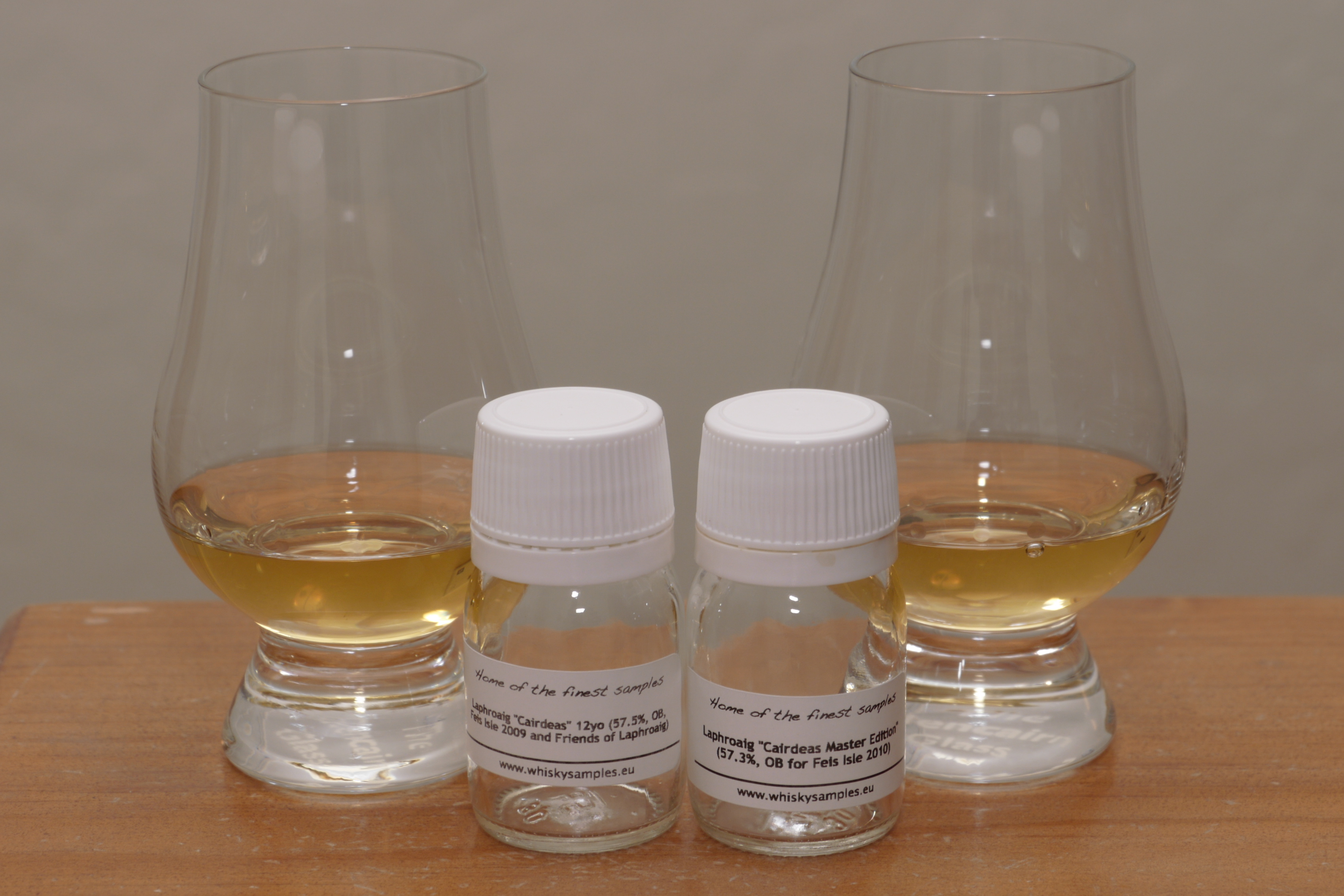
Last year, after following Feis Ile vicariously through other blog posts, I ordered some festival samples, including the Laphroaig Cairdeas [car-chase] 2009 release, which I did a post on here . I went to do the same this year for the 2010 release, and discovered that whiskysamples.eu had a few extra samples of the 2009 Cairdeas in stock as well, so I ordered both. I decided to compare both of the Cairdeas cask strength releases with the standard Laphroaig 10 CS Batch 001 release to see how they stacked up.

The 2009 Cairdeas release was a 12 year, specially selected by John Campbell, distillery manager for Laphroaig. The 2010 release was created by Master Distiller Robert Hicks, and is a vatting of first-fill and refill bourbon casks ranging from 11 to 19 years old. All three of the sampled cask strength Laphroaigs fall between 57% and 58% ABV.

Laphroaig Cairdeas 2009 and 2010

Tasting Notes

10 year CS Batch 001 (57.8%) – A phenol-lover’s delight. Iodine, campfire smoke, tar, and cedar wood stand out on the nose, contrasted against a sweet background with a little bit of fruit (apples?). Plenty of tar on the palate, with a good pepper and alcohol kick. The finish is long and smoky, with the tar and cedar wood coming through loud and clear. 88 Points.

Cairdeas 2009 12 year (57.5%) – Start with the traits of the 10 CS, but add more wood influence, with an especially striking helping of vanilla on the nose. It also seems to have slightly less smoke/tar. The palate and finish are again similar to 10 CS, but with more pepper. Just the right amount of pepper, in fact. My mouth is tingling just thinking about how this one went down, and how alive it made my tongue feel. Great balance! 90 Points.

Cairdeas Master Edition 2010 (57.3%) – Surprisingly close to the 10 CS again, considering this one was made from a vatting of different aged and types of casks. The main difference being that this Feis Ile release is more fruity. Citrus and/or apples are present, taking a bit of the edge off of the phenol attack. Not as much vanilla as the 2009 Feis Ile bottling, and not as much pepper, either. 88 Points.

Bottom Line

The Feis Ile cask strength Lapharoaigs are excellent, and totally worth the festival asking prices of around $60-$70. I especially like the 2009 bottling, and kind of wish I had bought a bottle for $100 when I had the chance last year. The extra vanilla and the brilliant mouth feel, combined with the fact that it’s a limited release, make it worth seeking out. The 2010 version, while a bit more fruity than the standard 10 CS, didn’t strike me as necessarily “better.”

While I think the 2009 Cairdeas is worth a little bit of a premium, I would not consider paying high eBay prices for either of the Feis Ile releases. The standard 10 CS is more than good enough to satisfy my cravings for a cask strength Laphroaig experience. I also find that I can get a little bit of additional complexity (vanilla/fruit) by vatting 2 parts 10 CS and 1 part Laphroaig 18 year. It’s not quite on par with the 2009 Feis Ile experience, but still very good. Not sure if I’m venturing into heretic territory by suggesting such a home vatting, though…

Other Opinions

Check out these great reviews of the same expressions on two of my favorite whisky review sites:

Whisky Fun10 CS Batch 001 (Great point about the medicinal notes being “whiffs” rather than in your face); Cairdeas 12 2009 (and 10 CS Batch 001)

WhiskyNotes.be10 CS Batch 001 (87 pts); Cairdeas 12 2009 (88 pts); Cairdeas master Edition 2010 (86 pts & comparison with ’08/’09)

Cheers,
Jeff

Introduction

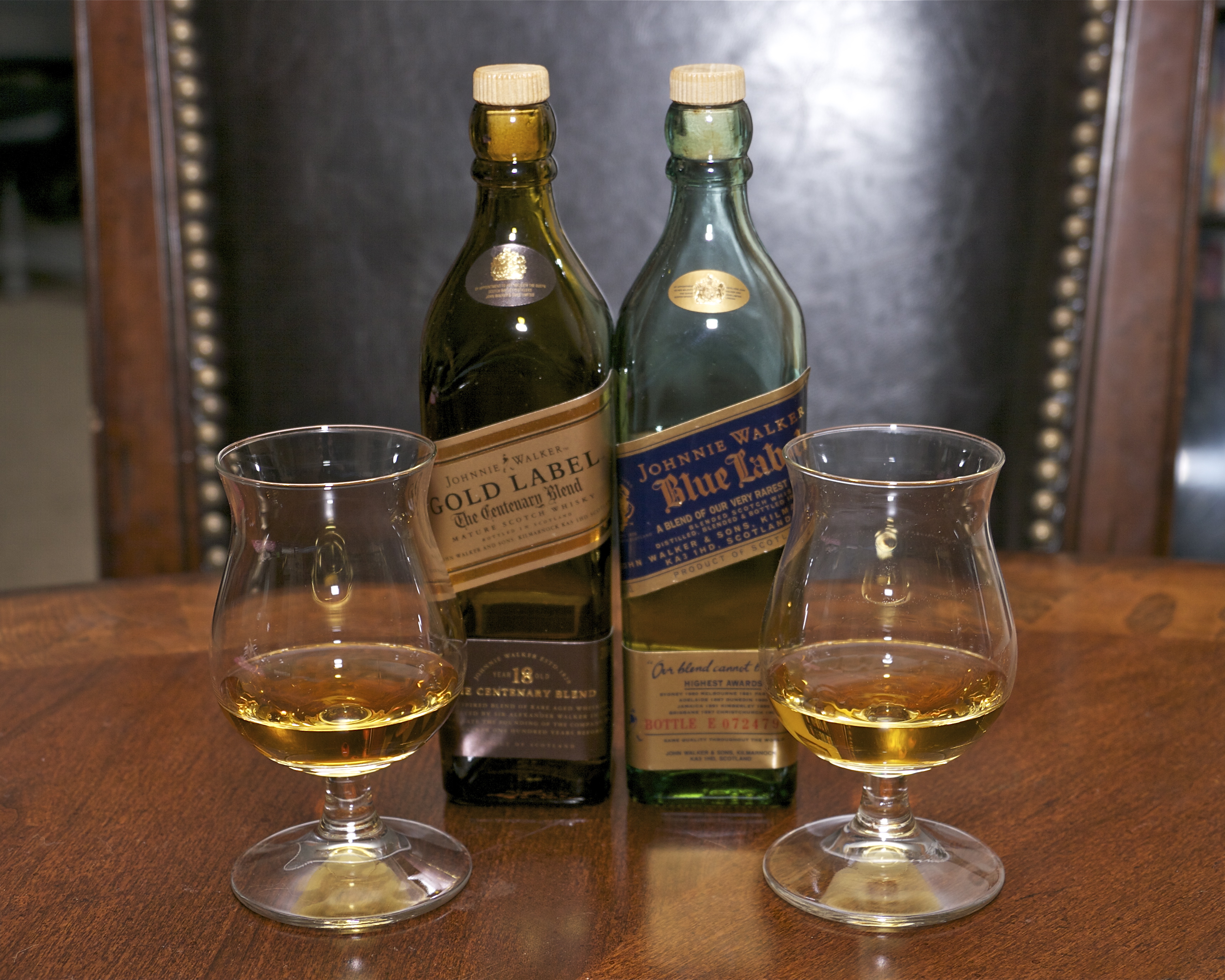
I bought a 200ml bottle of JW Gold a while back to see what all of the fuss was about (people seem to rave over this particular expression relative to the more expensive JW Blue). I also have a 200ml bottle of JW Blue that I got from, of all people, a marketing firm representing Chivas Regal. I got it along with a 200ml Chivas 18 bottle just before Christmas, as did a bunch of other online bloggers and spirits writers. I find the Gold/Blue comparison much more interesting than Chivas 18/JW Blue, so that’s what I’m going to write about in this post.

Johnnie Walker's Gold and Blue

Taste Comparison

Nose:

  • JW Gold – Slightly medicinal, earthy peat, and some smoke. There is also some toffee sweetness and wood of the cedar block variety. There really seems to be a strong Talisker presence.
  • JW Blue – There is peat and smoke, but it’s more subdued than with Gold. Then a really rich vanilla and dried red fruits. You really have to stick your nose in there and take a big whiff to get the most of it. There is also a really nice cinnamon/nutmeg presence.
  • Comments – On first sniff, the Gold stands out, and would probably appeal more to the single malt aficionado. Though more subtle, the Blue is overall darker, richer and more complex. More luxurious, if you will.

Palate:

  • JW Gold – Ugh…what happened? It’s totally flat, like a Talisker watered down to 15% abv. Nothing offensive, but pretty forgettable.
  • JW Blue – Much thicker palate than the Gold, with a nice sweet peat flavor. There’s some white pepper that adds life to the party, but doesn’t overwhelm.
  • Comments – Big win for J.W. Blue.

Finish:

  • JW Gold – A nice burst of peaty smoke rushes up the back of the nostrils. On the tongue, however, it continues to be flat, leaving a grainy taste on the tongue that reminds me of a younger blend.
  • JW Blue – More subtle hints of smoke in the nostrils, with hints of peat and toffee sticking to the tongue for a while. No graininess or anything off-putting.
  • Comments – The Gold was off to a great start, but screamed blend on the tongue. Neither one of these stands out on the finish relative to a good single malt, but your occasional drinker friends will delight in proclaiming how smooth the JW Blue is.

Conclusion

The bottling code on my 200ml bottle of Johnnie Walker Gold starts with L4, which I understand to mean it was bottled in 2004. When I read  reviews of J.W. Gold by Jim Murray, Paul Pacult, and by numerous single malt aficionados on message boards, I can’t help but wonder if something less than ideal happened to my bottle between the time it was produced and the time I bought it. I mean, it’s got a great nose, and the finish has its moments, but it’s otherwise so flat, I find it hard to believe it would get such raves. I like it just fine, and would probably give it a solid 84 points on my scale. It would need a much more memorable palate and finish to rate more highly.

Johnnie Walker Blue provides a thoroughly enjoyable blended whisky experience. Where as the Gold had me imagining I could taste specific distilleries…Talisker, Oban or Clynelish, etc., the Blue had me thinking of the actual flavors…smoke, berries, spices. It has been blended into its own flavor profile that hits on a lot of notes that I tend to favor. The nose is a bit reserved, but it rewards time and effort. There’s enough complexity to keep you interested for a while, and it’s super smooth. Just right for the occasional scotch drinker who wants to experience a luxury spirit. I’m going to rate it 88 points.

Is the J.W. Blue worth the $175 – $225 price that it typically commands? On taste alone, of course not. But that’s not the point. As a gift to impress somebody, the Blue Label should satisfy, with its distinctive packaging and prominent recognition (due to great marketing). I’d much rather drink Laphroaig 30 year, which was going for $200 to $250 a couple of years back, but will the occasional drinker appreciate that one as much? What about the fact that you’re going to have to sit there and explain to them why it’s a “special” whisky, and why it’s about the spirit inside, not the bottle/box it comes in? I don’t have any immediate plans to purchase a 750ml bottle of J.W. Blue, but I don’t have any issue with others doing so, and if I were to get this as a gift, I’d be very appreciative and enjoy drinking it. There’s definitely a place for a whisky like this, and I think it hits the mark for what they’re trying to accomplish.

Cheers,
Jeff